Math

Explanation
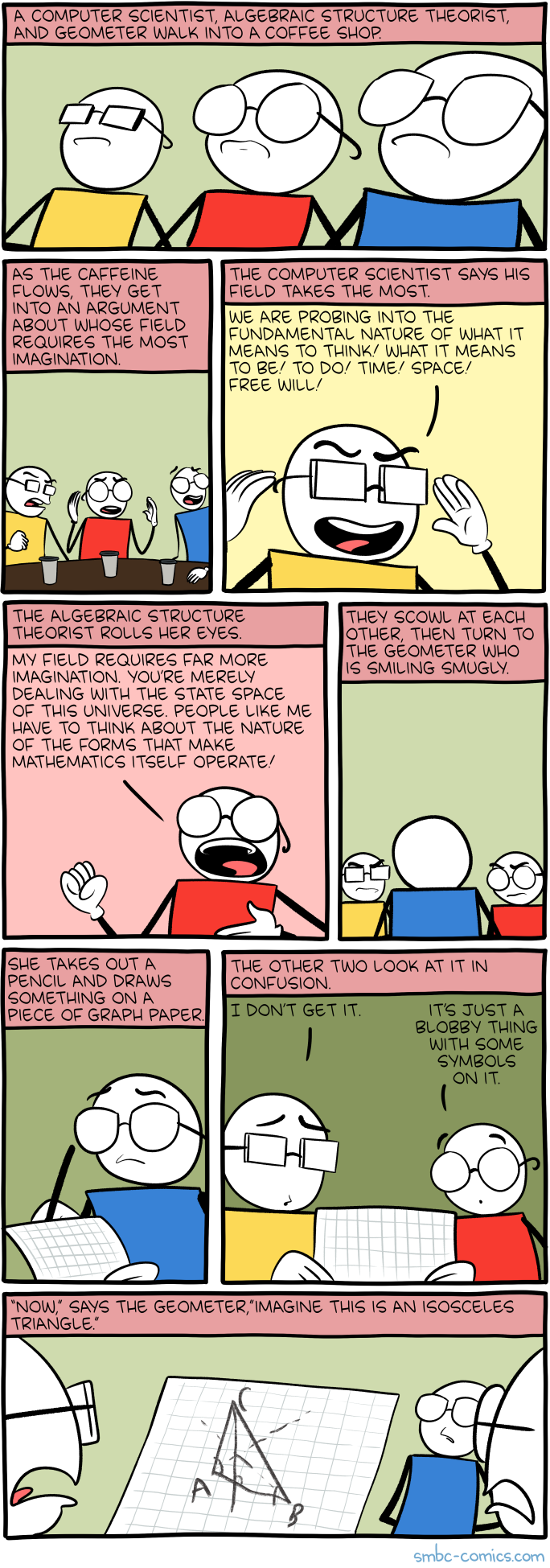
A computer scientist, an algebraic structures theorist, and a geometer walk into a coffee shop. As the caffeine kicks in, they get into an argument about whose field "requires the most imagination."
The computer scientist says his field "gave us things that most people can barely imagine." The algebraic structures theorist argues: "We are probing into the fundamental nature of what it means to think about time, space, free will." The theorist then escalates: "My field requires more imagination! You're merely dealing with the state space of the universe. People like me think about the nature of the forms that make mathematics itself operate!"
The geometer, who has been silent throughout, takes out a pencil and draws something on a piece of paper. The other two look at it: "I don't get it." "It's just a squiggly thing with some coordinates on it."
The caption reads: "'Now,' says the geometer, 'imagine this is an isosceles triangle.'" A rough sketch is shown.
The joke operates on multiple levels. First, it parodies the common "X walks into a bar" format. Second, it satirizes academic turf wars about which field of mathematics is the most abstract or requires the most imagination. But the real punchline is that the geometer wins the argument by demonstrating imagination in its most literal and humble form: looking at a rough, imperfect drawing and imagining it as a perfect geometric shape. While the other two are arguing about cosmic abstraction, the geometer points out that the most fundamental act of mathematical imagination is the one we all do first -- looking at an imperfect figure and seeing the ideal form it represents. This is a deep point about geometry: every geometric proof starts with a diagram that is, by necessity, imperfect, yet we reason about it as though it were exact.