math-and-war
Explanation
The Joke
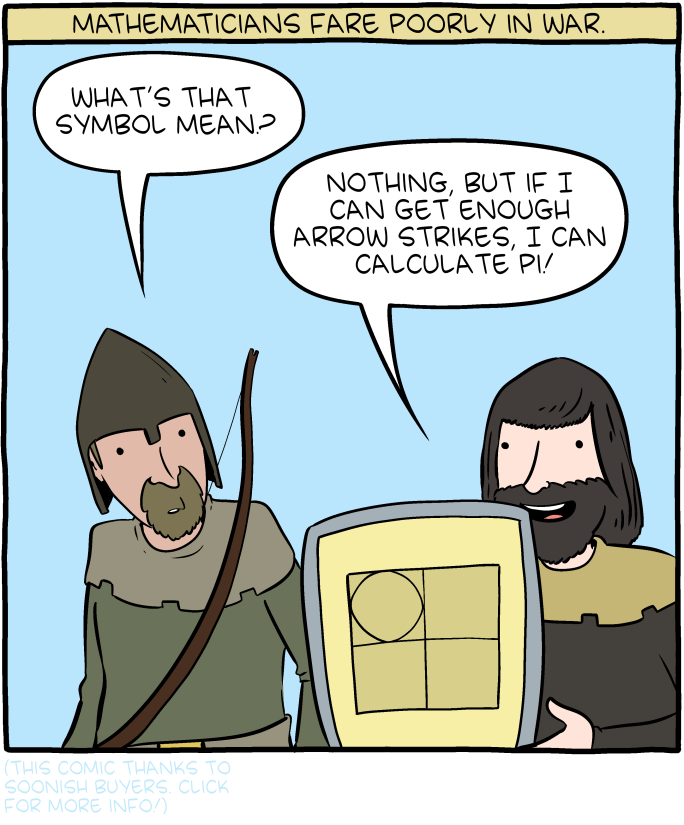
The comic is titled "Mathematicians Fare Poorly in War." A medieval archer asks a fellow soldier about the symbol drawn on his shield. The shield has a circle inscribed in a square with grid lines. The soldier cheerfully explains that the symbol means nothing in itself, but if he can get enough arrow strikes on the shield, he can calculate pi.
Rather than using his shield for protection in battle, this mathematician-soldier is using it as a Monte Carlo simulation device. He is hoping that enemy arrows will land randomly on his shield so he can estimate pi by comparing the number of arrows that land inside the circle to the total number that land on the square.
The Humor
The joke works on multiple levels. First, there is the absurdity of a soldier going to war not to fight but to conduct a mathematics experiment, using enemy fire as his source of random data. Second, the title "Mathematicians Fare Poorly in War" is a dry understatement -- this man is going to fare poorly because he is actively trying to get shot at rather than defending himself. Third, the Monte Carlo method for estimating pi is a real mathematical technique, but it normally uses computer-generated random numbers, not actual projectiles aimed at your body. The mathematician's enthusiasm about arrow strikes is hilariously misplaced given the life-threatening context.
References
The comic references the Monte Carlo method for estimating pi. By randomly sampling points within a square and checking whether they fall inside an inscribed circle, the ratio of hits inside the circle to total hits converges on pi/4. This technique is commonly taught in introductory probability and computational mathematics courses. The method is named after the Monte Carlo Casino in Monaco and was developed formally during the Manhattan Project in the 1940s.