math-puzzles
.png)
Explanation
The Joke
A tip is offered for math students: if you change a logic puzzle so it is easy, no professor will ever have the nerve to guess the right solution. We then see a student labeled as a "lazy unsolvable puzzler" presenting a problem to a professor. The student says: "Two people are running toward each other on a straight road. They are one mile apart and both are running at ten miles per hour. Will they ever pass each other?"
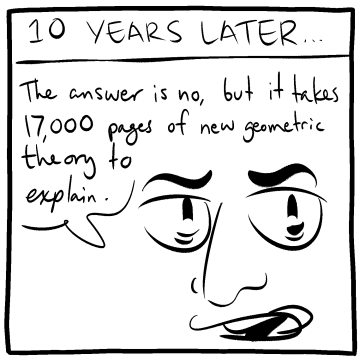
The professor responds with a bewildered "Oh ho ho! You are tricky, aren't you?" — clearly overthinking what is actually a trivially simple problem.
The Humor
The joke plays on the expectation that math puzzles presented to professors must be tricky. Classic math puzzles (like Zeno's paradoxes or complex convergence problems) are designed to be deceptively difficult, so professors are trained to look for hidden complexity. The student exploits this by presenting a problem that is laughably straightforward — two people running toward each other at 10 mph from 1 mile apart will obviously meet in about 3 minutes and then pass each other.
But because the professor expects trickery, he assumes there must be some clever twist or trap he is missing. The humor lies in the irony that making a problem too easy is itself a form of deception — the professor cannot fathom that a student would present a genuinely simple problem, so he overthinks it into being "unsolvable." It is a satire of academic culture where simplicity is the most unexpected trick of all.
References
The comic riffs on classic mathematical puzzles involving relative motion, such as the famous "fly between two trains" problem, where two trains approach each other and a fly bounces between them. Those problems are designed to seem harder than they are. Here, the student has gone in the opposite direction, making the problem genuinely trivial but exploiting the professor's expectation of complexity.