mean
Explanation
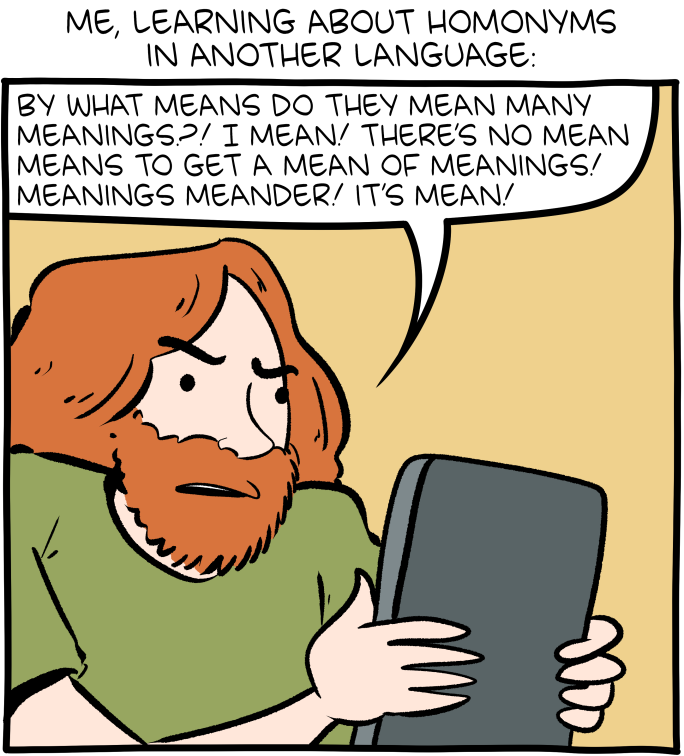
This single-panel comic is captioned "Me, learning about homonyms in another language" and shows a bearded man staring at a tablet or book with mounting frustration, exclaiming: "By what means do they mean many meanings?! I mean! There's no mean means to get a mean of meanings! Meanings meander! It's mean!"
The joke is built entirely on the word "mean," which is itself a perfect example of the very concept that's frustrating the speaker. In English, "mean" can refer to: an intention or definition ("what do you mean?"), an average ("the mean value"), a method ("by what means"), cruelty ("that's mean"), and the verb "to meander" shares the same root. The character's complaint about homonyms -- words that share the same spelling or pronunciation but have different meanings -- is expressed using a cascade of homonyms, creating a self-referential loop of confusion.
The humor works because the frustration is entirely relatable to anyone who has studied a foreign language and encountered words with multiple unrelated meanings. But the meta-joke is that English is just as guilty of this as any other language, and the character is inadvertently demonstrating that fact in their own rant. The comic is essentially a linguistic tongue-twister disguised as a complaint, and the increasingly unhinged tone of the speech mirrors the genuine exasperation that language learners feel when they realize that vocabulary is not a simple one-to-one mapping between words and concepts.