Meat
Explanation
The Joke
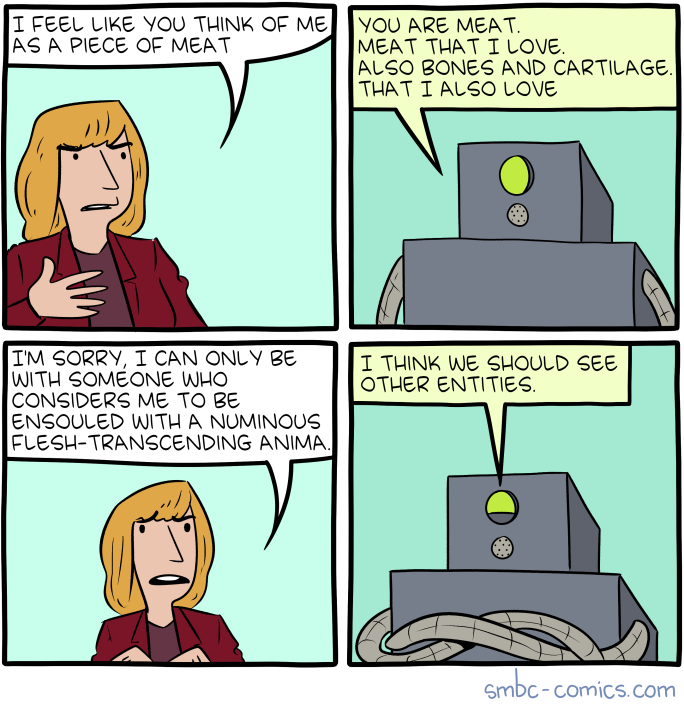
A woman says to a robot: "I feel like you think of me as a piece of meat." The robot responds with perfect literalism: "You are meat. Meat that I love. Also bones and cartilage. That I also love." The woman, unsatisfied, says: "I'm sorry, I can only be with someone who considers me to be ensouled with a numinous, flesh-transcending anima." The robot replies: "I think we should see other entities."
The Humor
The comic plays on the phrase "you think of me as a piece of meat," which in human relationships is a complaint about being objectified or reduced to one's physical body. When a robot partner takes this literally, it becomes a clash between materialist and dualist worldviews. The robot is being perfectly accurate and perfectly loving -- from its perspective, acknowledging that a human is made of meat, bones, and cartilage and loving all of those components is the highest form of devotion. But the human demands something the robot cannot provide: belief in a soul, a "numinous, flesh-transcending anima." The breakup is funny because both parties are being entirely reasonable within their own frameworks -- the robot cannot believe in something immaterial, and the human cannot accept a purely material account of her being. The robot's use of "other entities" instead of "other people" is a perfect final touch, reminding us that from its perspective, the categories are different.
References
The comic touches on the philosophical mind-body problem and the debate between materialism (the view that humans are entirely physical) and dualism (the view that humans have an immaterial soul or mind). "Anima" is the Latin word for soul, used in various philosophical and psychological traditions, including Carl Jung's analytical psychology where it refers to the inner feminine side of men.