melville
Explanation
The Joke
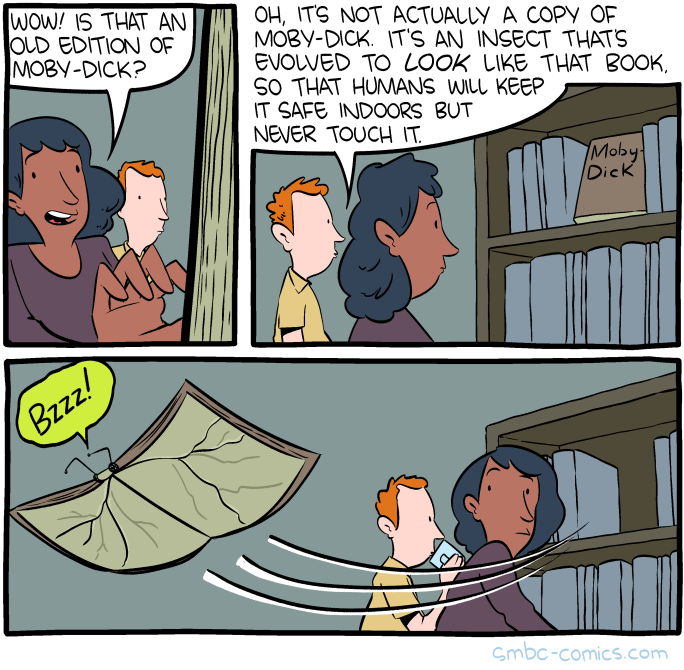
A group of people are looking at a bookshelf when one exclaims, "Wow! Is that an old edition of Moby-Dick?" Another person explains, "Oh, it's not actually a copy of Moby-Dick. It's an insect that's evolved to look like that book, so that humans will keep it safe indoors but never touch it." In the second panel, the "book" flies off the shelf buzzing ("Bzzz!"), revealed to be a large insect with wings that mimic the appearance of a book's pages and cover.
The joke imagines a form of mimicry in nature specifically adapted to exploit human behavior around classic literature. The insect has evolved to look like a copy of Moby-Dick because people tend to own copies of famous literary classics that they proudly display on shelves but never actually read -- providing the insect with a perfect habitat: a safe, indoor, undisturbed environment.
The Humor
The comedy works as both a clever biology gag and a jab at literary pretension. The concept of mimicry is real in nature -- insects evolve to look like leaves, sticks, or even other more dangerous insects to avoid predation. The joke extends this to the cultural observation that many people own copies of long, intimidating literary classics (Moby-Dick being a prime example) that sit on shelves purely for show. The alt text reinforces this: "Anyone emailing me to mention that Moby-Dick is actually a good book will be forced to sit in town square on a short stool, wearing a hat that reads 'stater of the obvious.'" Weinersmith isn't saying the book is bad -- he's saying most people don't read it despite owning it.
References
- Biological mimicry: Many species have evolved to resemble other objects or organisms for survival advantage. Examples include stick insects, leaf insects, and the viceroy butterfly mimicking the monarch.
- Moby-Dick by Herman Melville (1851): The title of the comic, "Melville," references the author. The novel is famously long and dense, making it a canonical example of a "classic everyone owns but few actually read." It is regularly cited in surveys of books people lie about having finished.