metaphysics
Explanation
The Joke
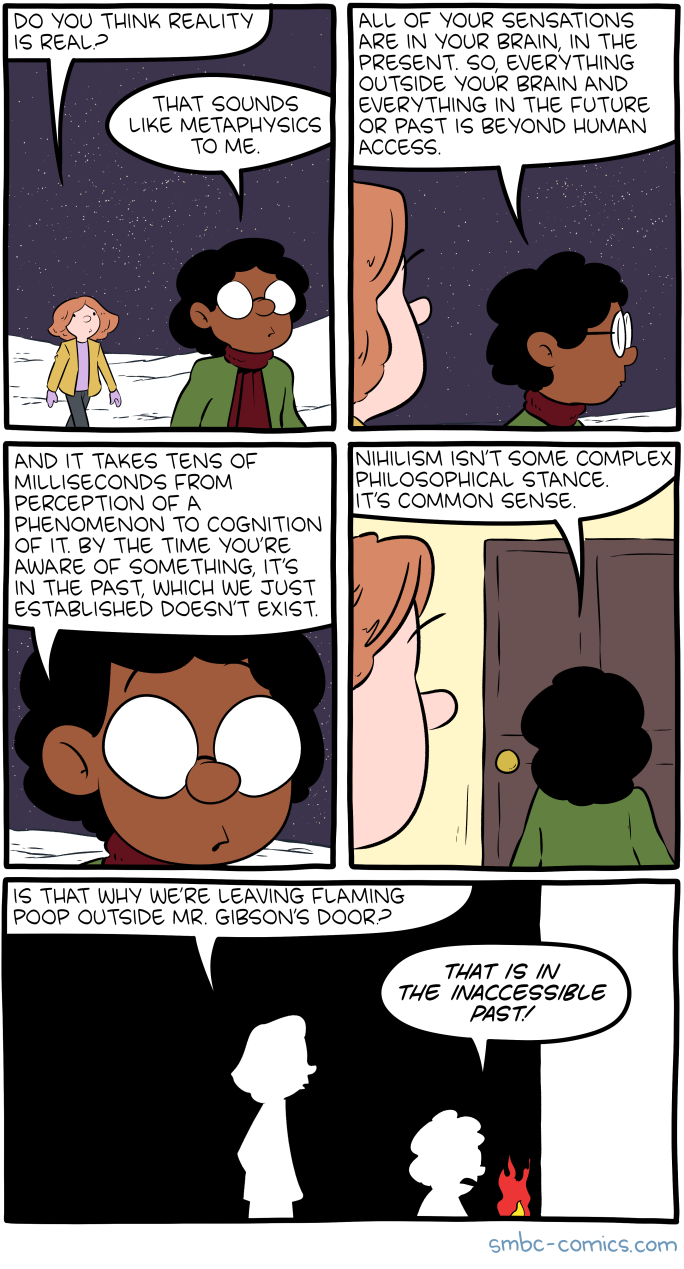
A woman asks a man whether he thinks reality is real, or if all of our sensations are merely produced by our brains, with the "true nature" of reality being beyond human access. The man dismisses this as metaphysics, but the woman persists, explaining that it takes tons of philosophical work to get from raw sensory phenomena to a coherent understanding of reality, and that the "true" nature of things may be fundamentally inaccessible to us. The man then raises a very mundane question: is that why someone keeps leaving a mysterious poop outside his office door? The woman, without missing a beat, confirms that the identity of the phantom pooper is indeed part of "the inaccessible part" of reality.
The comic sets up a classic philosophical discussion about metaphysics and the nature of reality -- specifically the Kantian distinction between phenomena (things as we experience them) and noumena (things as they truly are). But the punchline deflates this lofty intellectual framework by applying it to a completely trivial and gross mystery: who keeps pooping outside someone's office. The woman's deadpan confirmation that the pooper's identity belongs to the "inaccessible" realm of reality is the final absurd twist.
The Humor
The humor works through a bait-and-switch from high philosophy to low comedy. The comic carefully builds up a genuinely substantive discussion about epistemology and the limits of human knowledge, only to crash-land into a scatological office mystery. The woman's willingness to seamlessly fold the poop question into her philosophical framework -- rather than being offended or confused -- makes it even funnier, as though unsolvable bathroom mysteries are a perfectly natural example of the unknowable noumenal world.
References
The comic references key concepts from metaphysics and epistemology, particularly Immanuel Kant's distinction between phenomena and noumena -- the idea that we can only ever perceive the world through the filter of our senses and cognitive structures, and that "things-in-themselves" remain forever inaccessible.