milton
Explanation
The Joke
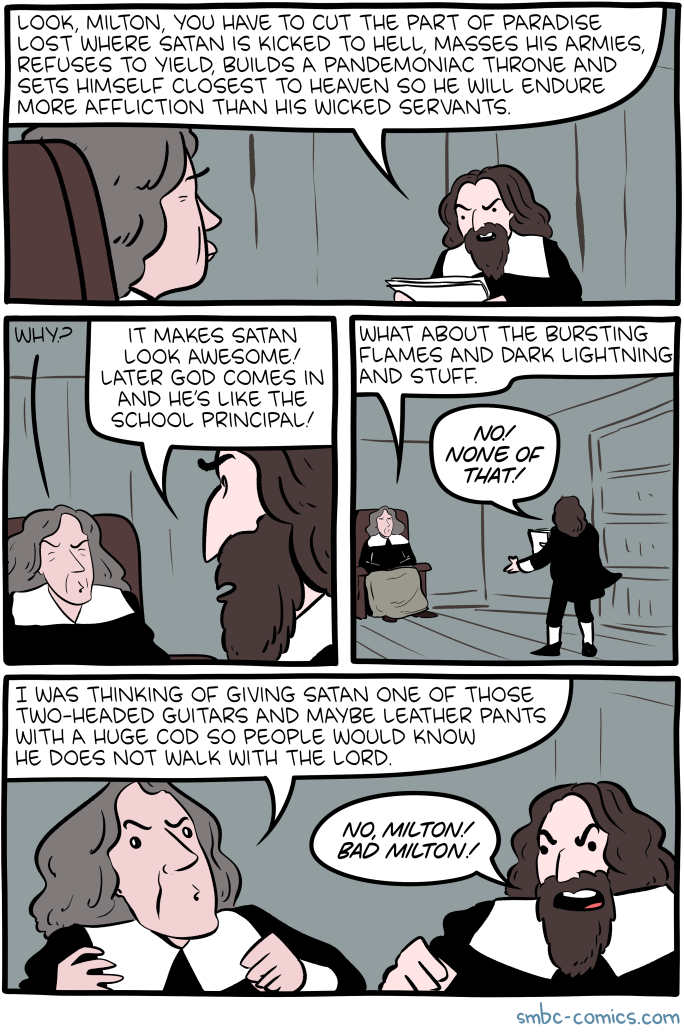
Someone is discussing John Milton's Paradise Lost with what appears to be Milton himself (or a figure representing him). They note that Milton needs to cut the part where Satan, cast into hell, "decides to yield, building a 'Pandemonium' — turns out it's a big enough condo to house his wicked servants." In the next panel, Milton's collaborator says they think Satan should "look awesome — like a God coming in and he's the tall school principal."
Milton responds that Satan "bumbles and does lame lightning." Someone suggests giving Satan "one of those 'Magnificent Bastard' type of those painted paintings with a huge ego so people would know he does not take stuff lying down." The final response is: "No, Milton! Bad Milton!"
The Humor
The comic dramatizes the famous literary-critical observation that Satan is the most compelling and charismatic character in Paradise Lost. Milton intended Satan to be the villain, but many readers (most famously the Romantic poets like Blake and Shelley) have noted that Satan comes across as a heroic, sympathetic rebel. The comic imagines this happening in real time during the writing process, with Milton being scolded like a misbehaving dog ("Bad Milton!") for making Satan too cool.
The humor lies in the tension between Milton's supposed intent (Satan should be pathetic and bumbling) and his actual creative instincts (making Satan magnificent and imposing). His collaborator keeps trying to make Satan lame, but Milton can't help wanting to make the devil awesome.
Broader Context
This comic engages with one of the oldest debates in English literature — whether Milton was "of the Devil's party without knowing it," as William Blake put it. SMBC frequently draws humor from literary and philosophical history, and this comic assumes a readership familiar with the Paradise Lost discourse. Weinersmith often finds comedy in the gap between an artist's stated intentions and the actual effect of their work.