minority-report
.png)
Explanation
The Joke
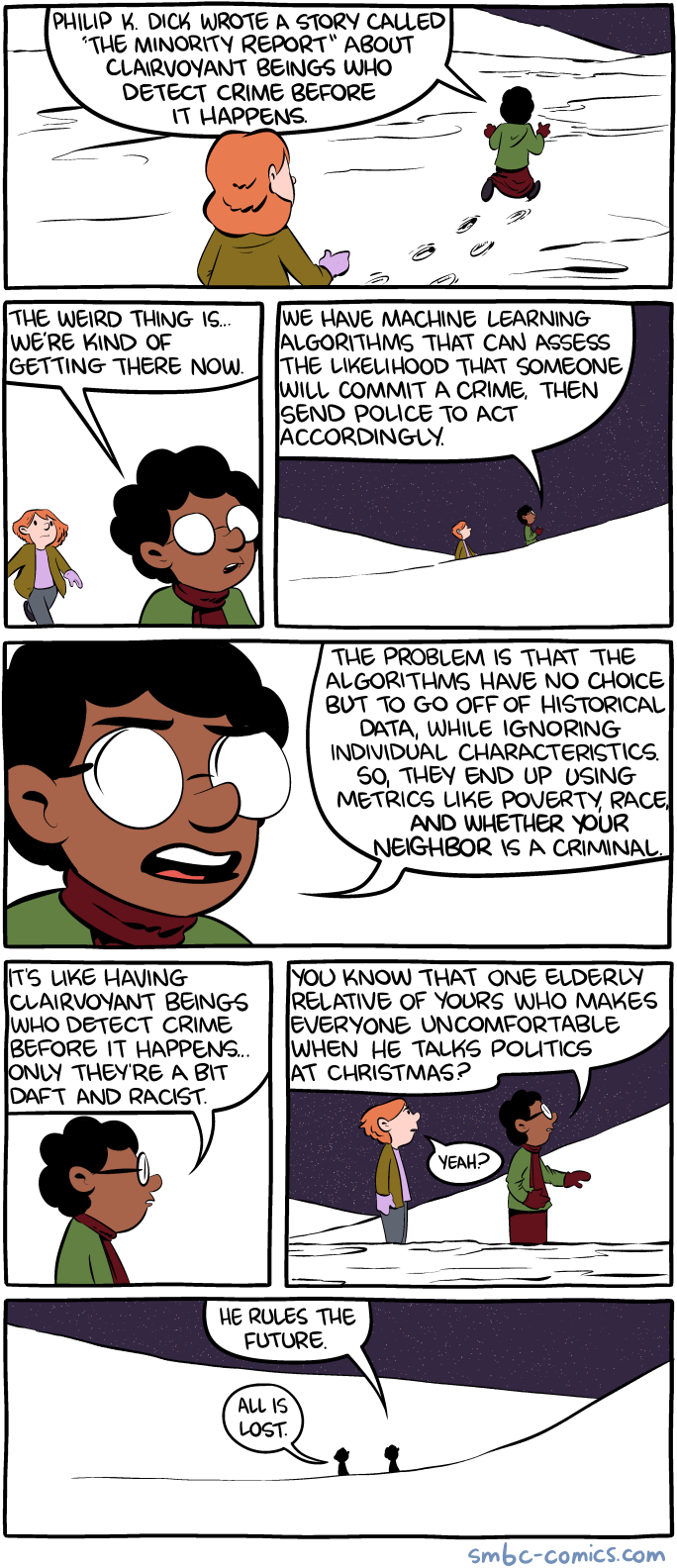
A character explains the premise of the Philip K. Dick story "The Minority Report," in which clairvoyant beings can detect crimes before they happen, allowing police to arrest people preemptively. She then notes: "The weird thing is, we are kind of getting there now." She describes machine learning algorithms that can assess the likelihood that someone will commit a crime and then direct police accordingly.
The catch, she explains, is that these algorithms rely on historical data, which means they incorporate existing biases -- they go by indicators like neighborhood characteristics, poverty rate, and other socioeconomic metrics rather than individual behavior. She compares it to having a neighbor predict whether you are a criminal based on uncomfortable metrics like race, class, and politics. The final panel sarcastically quips: "We made the future! ...Wait."
The Humor
The comic uses the sci-fi premise of "Minority Report" as a vehicle to critique real-world predictive policing algorithms. The humor is darkly ironic: we have achieved something resembling the futuristic crime-prediction technology from the story, but instead of psychic precognition, we got biased statistical models that essentially replicate and automate existing prejudices. The "we made the future" punchline drips with sarcasm, as this version of the future is far less impressive and far more troubling than the science fiction version.
References
"The Minority Report" is a 1956 short story by Philip K. Dick, adapted into a 2002 film directed by Steven Spielberg starring Tom Cruise. The comic references real predictive policing tools like PredPol (now Geolitica) and similar machine learning systems that have been widely criticized for perpetuating racial and socioeconomic biases. Studies have shown these systems disproportionately target communities of color and low-income neighborhoods because they are trained on historically biased arrest data.