miracle
Explanation
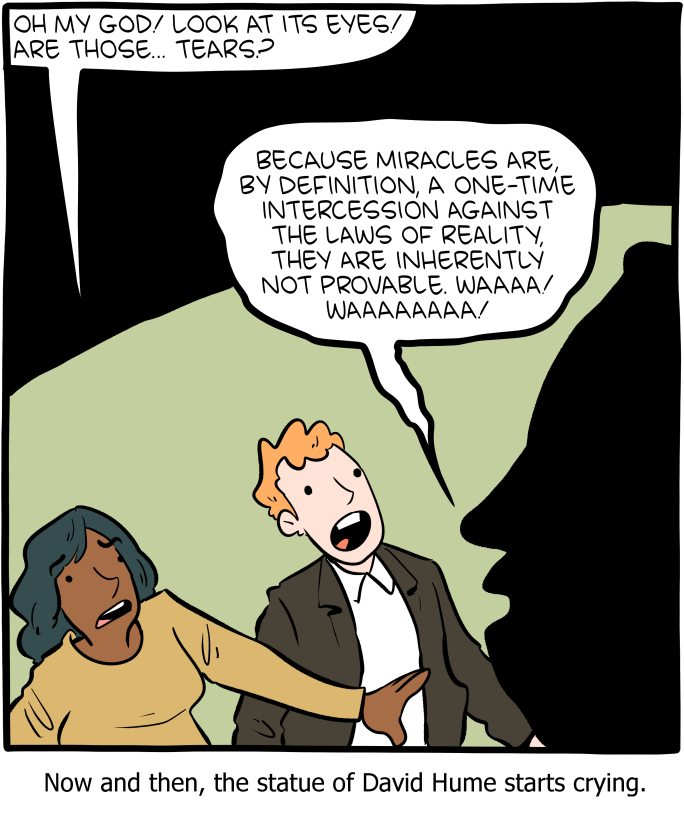
The comic shows two people observing something remarkable: a statue that appears to be crying. One person exclaims, "Oh my God! Look at its eyes! Are those... tears?" But instead of witnessing a genuine miracle, the statue is actually reciting the philosophical argument of David Hume against miracles: "Because miracles are, by definition, a one-time intercession against the laws of reality, they are inherently not provable. WAAAA! WAAAAAAA!"
The caption reads: "Now and then, the statue of David Hume starts crying."
The joke is a brilliant paradox. David Hume (1711-1776) was a Scottish Enlightenment philosopher famous for his skeptical arguments against miracles. In his "Enquiry Concerning Human Understanding," Hume argued that miracles -- being violations of natural law -- can never be sufficiently supported by testimony, because it is always more probable that the testimony is false than that a miracle actually occurred. A miracle, by definition, is the least likely explanation for any event.
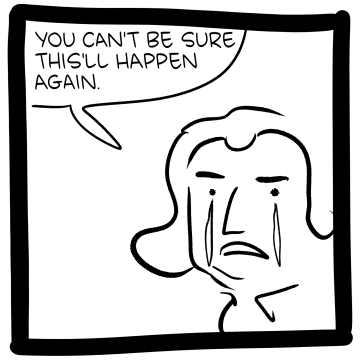
The comic creates a delicious self-referential contradiction: a statue of Hume is itself performing a miracle (crying and speaking), but the content of its miraculous speech is Hume's own argument that miracles cannot be proven. The statue is literally disproving its own existence as a miracle while performing one. The "WAAAA!" crying sounds serve double duty -- they are both the sound of actual weeping (the miraculous tears) and a baby-like wailing that makes Hume's sophisticated philosophical argument sound petulant and whiny.
There is also a layer of satire about "weeping statue" miracles, which are a recurring phenomenon in religious contexts (weeping Madonnas, bleeding icons, etc.) and are frequently investigated and debunked. Having the statue of a famous skeptic be the one that weeps -- and weeps skepticism -- is a perfect comedic inversion.