model
Explanation
The Joke
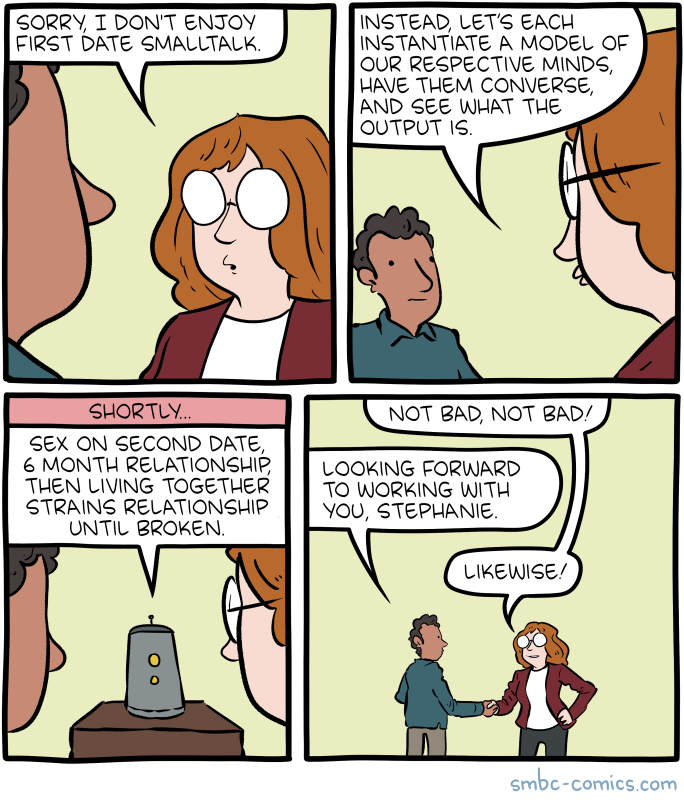
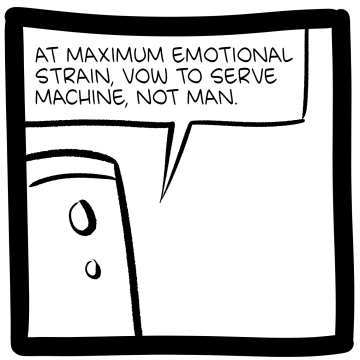
A couple on a date decides they don't enjoy "doing this simulation directly." Instead, they propose building a model of their respective minds and then running the simulation to see what the output would be. In the next panel, the "output" is presented: "Sex on second date, 6-month relationship, she likes you forever, you like her until broken." Both characters respond positively — the woman says "Not bad, not bad" and the man says "Looking forward to working with you, Stephanie." They shake hands professionally, and both say "Likewise."
The Humor
The comic satirizes the modern tendency to optimize and rationalize everything, including romance. Rather than actually experiencing a relationship — with its messy emotions, uncertainty, and vulnerability — these two people prefer to simulate the entire thing computationally and review the results like a business report. The handshake and "looking forward to working with you" at the end perfectly captures how the entire romantic experience has been reduced to a professional transaction.
There's also a darkly funny honesty in the simulation output: he'll stop liking her eventually while she'll like him forever, and they both just... accept this as a satisfactory outcome. The asymmetry that would be devastating in real life is treated as an acceptable data point.
Broader Context
SMBC frequently explores how analytical and computational thinking can be absurdly misapplied to human relationships. This comic fits into Weinersmith's broader interest in how modeling and simulation, while powerful tools in science, become ridiculous when applied to the irreducibly messy domain of human emotion. It also touches on the idea that modern dating culture increasingly treats relationships as optimization problems rather than lived experiences.