monotreme
Explanation
The Joke
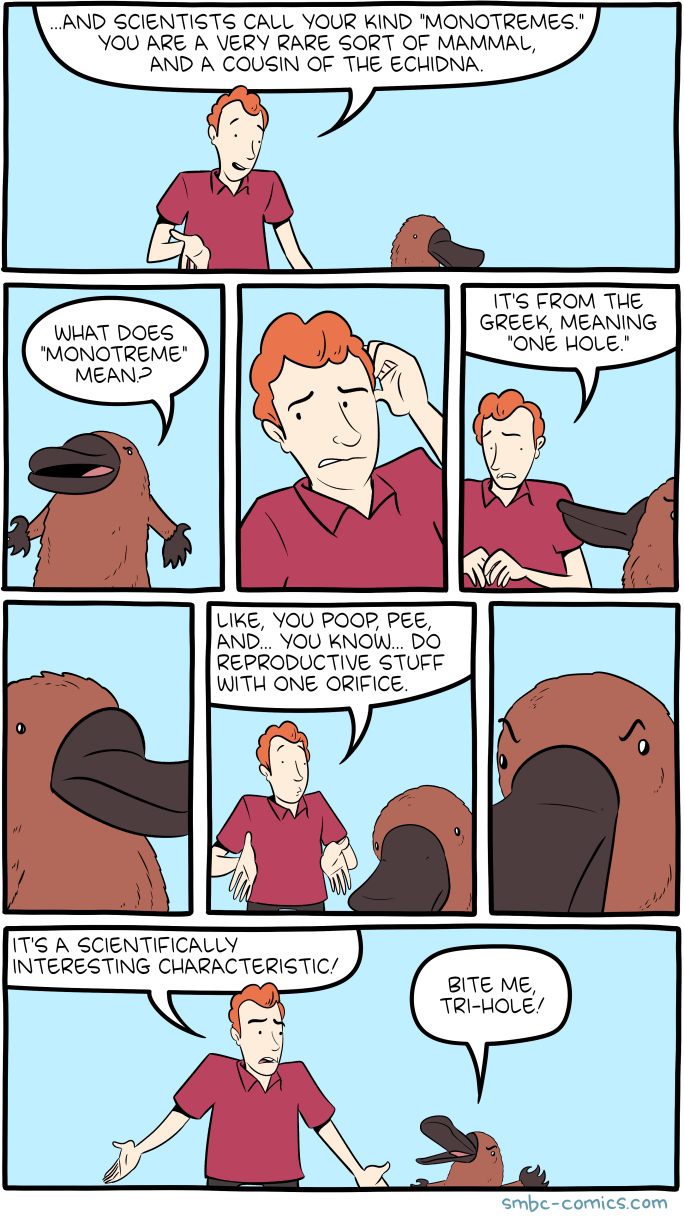
A scientist is excitedly telling an animal -- which appears to be a platypus or echidna -- about its classification: "And scientists call your kind 'monotremes.' You are a very rare sort of mammal, and a cousin of the echidna." The animal asks, "What does 'monotreme' mean?" The scientist explains it comes from Greek, meaning "one hole." The animal is confused, and the scientist awkwardly elaborates: "Like... you poop, pee, and... you know... do reproduction stuff... with one orifice." The animal pauses, then says, "It's a scientifically interesting characteristic!" But in the final panel, the animal simply responds: "Bite me, genius."
The joke centers on the embarrassing etymology of "monotreme." While the classification sounds dignified and scientific, its literal meaning is rather undignified: it refers to the fact that monotremes (platypuses and echidnas) have a single opening called a cloaca that serves for excretion, urination, and reproduction. The animal's irritation at being defined by this particular anatomical feature is entirely understandable.
The Humor
The comedy comes from the scientist's escalating discomfort as he has to explain what "monotreme" actually means. He starts with the grand, impressive-sounding scientific framing but is forced to get increasingly specific and awkward. The animal's deadpan "Bite me, genius" perfectly captures the indignity of having your entire taxonomic classification be "the thing with one hole." It's a reminder that scientific nomenclature, while precise, can be hilariously reductive -- imagine if humans were classified primarily by our most embarrassing anatomical feature.
References
Monotremes are one of three major groups of mammals (along with placentals and marsupials). The word comes from the Greek "monos" (single) and "trema" (hole), referring to the cloaca. Living monotremes include only the platypus and four species of echidna, all native to Australia and New Guinea. They are notable for being mammals that lay eggs.