Mood

Explanation
The Joke
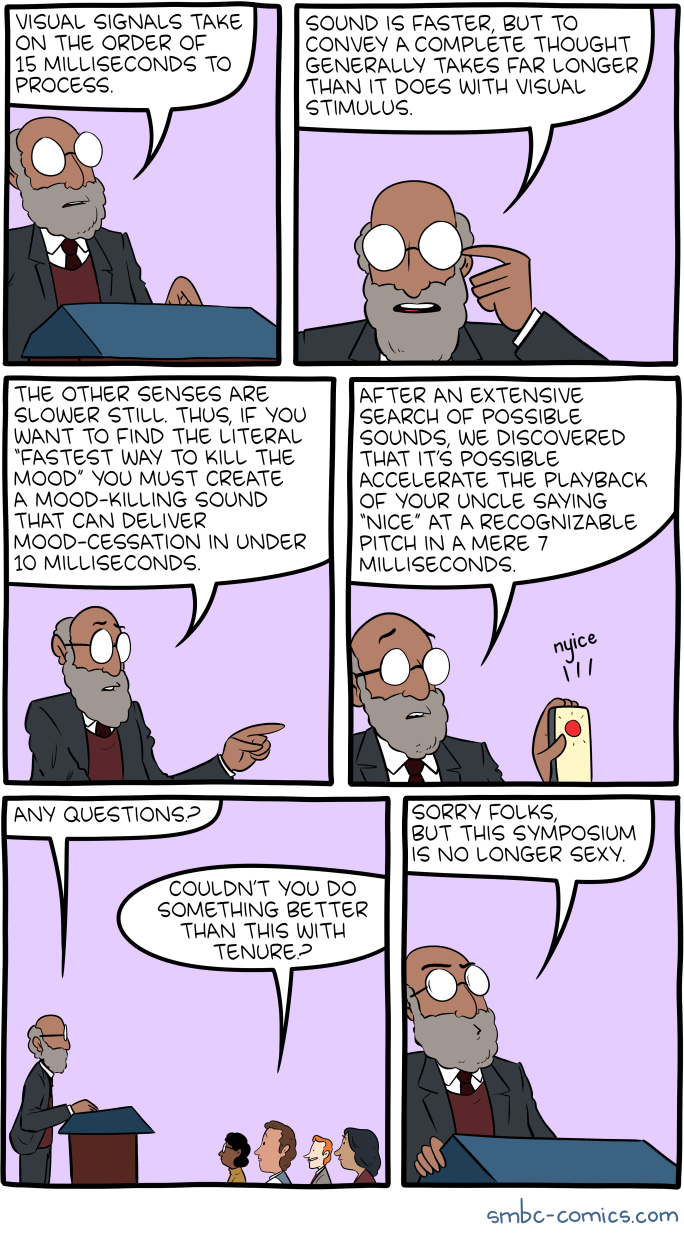
A scientist is giving a presentation about how the brain processes stimuli and mood. He explains that visual signals take 10 milliseconds to process, sound is faster, but a complex thought generally takes far longer than it does with visual stimulus. He continues: "The other senses are slower still. Thus, if you want to change your mood, you must create the right visual and auditory environment." He claims that after an extensive search of possible sounds, they discovered a way to "accelerate the playback of a recognizable tune" that can deliver a "recognizable mood-changing impression in under 20 milliseconds."
An audience member then asks: "Couldn't you do something better with this than turning this into a symposium?" The presenter responds: "Sort of, but the symposium is no longer the point." The implication is that the research has led to something far more significant or potentially dangerous than just an academic presentation, but the comic leaves the exact application ambiguous and ominous.
The Humor
The humor operates on the tension between the dry, technical presentation style and the increasingly unsettling implications of the research. What begins as a straightforward neuroscience lecture about processing speeds gradually reveals itself to be about a technology that can manipulate human mood nearly instantaneously. The audience member's question cuts through the academic veneer to ask the real question: why are you just giving a talk about this instead of using it? The presenter's evasive response suggests the technology has already moved beyond the presentation stage. The comic satirizes both the way academics can discuss world-changing (or world-threatening) discoveries in bland, technical language, and the naivety of assuming that research into mood manipulation would remain purely theoretical.