moral-dilemmas
Explanation
The Joke
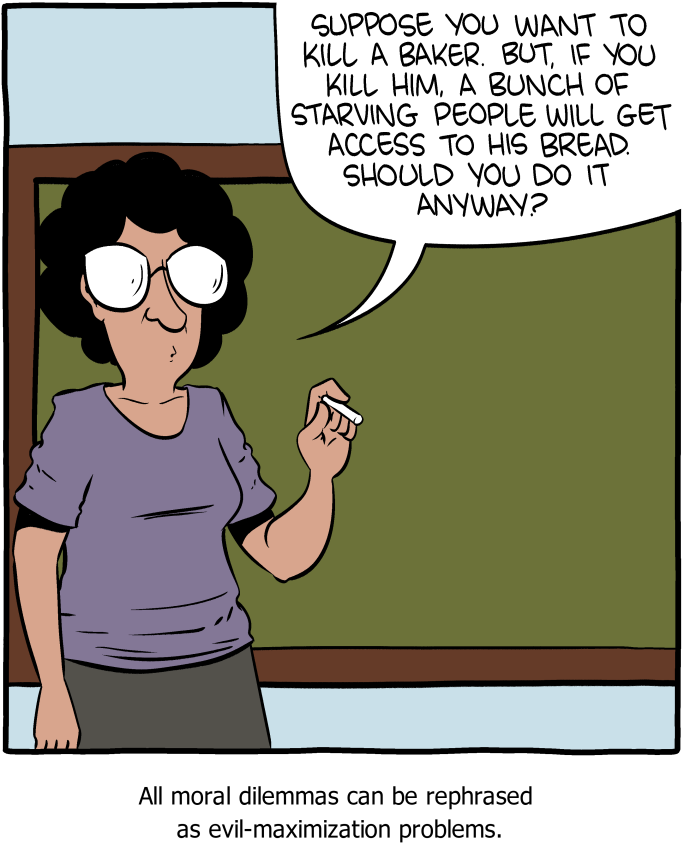
A philosophy professor stands at a chalkboard and poses what sounds like a classic ethical thought experiment: "Suppose you want to kill a baker. But, if you kill him, a bunch of starving people will get access to his bread. Should you do it anyway?" The caption below reads: "All moral dilemmas can be rephrased as evil-maximization problems."
The standard trolley-problem style moral dilemma typically frames the situation as: you do not want anyone to die, but circumstances force you to choose between bad outcomes. This comic inverts the framing entirely. Instead of a reluctant moral agent forced into a tragic choice, the premise starts with "suppose you WANT to kill a baker" -- the agent is already evil, and the positive outcome (feeding the starving) is merely an inconvenient side effect of the murder they were planning anyway.
The Humor
The comedy lies in the observation that the logical structure of many moral dilemmas is preserved even when you flip the moral polarity of the actor. A utilitarian calculus about whether the good consequences outweigh the bad works the same regardless of the agent's intent. By reframing the dilemma so the person actively wants to do the harmful thing, the comic exposes how the abstract structure of ethics problems can feel absurd when you change the motivational context. It also satirizes philosophy courses that endlessly pose variations on trolley problems, suggesting that with enough creative reframing, any moral question can be made to sound like a villain workshopping their plans.
References
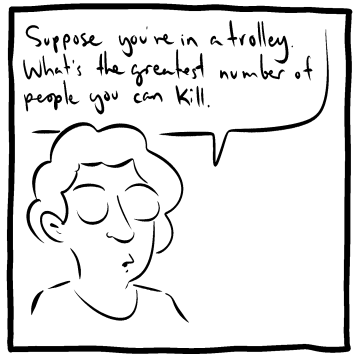
The comic parodies the Trolley Problem and similar utilitarian thought experiments popularized by philosopher Philippa Foot and widely used in introductory ethics courses.