More
Explanation
The Joke
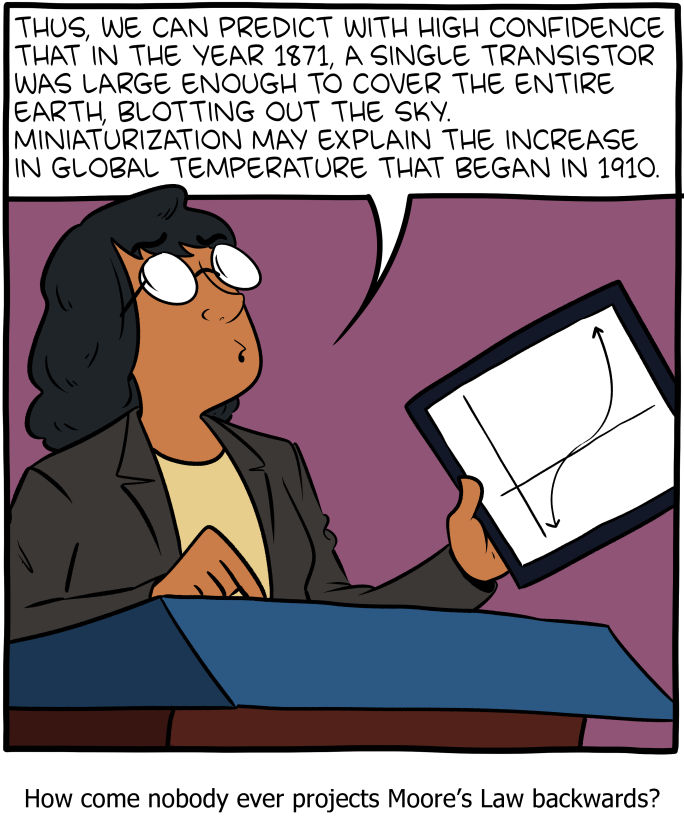
A scientist or researcher is presenting findings, explaining that they can predict with high confidence that in the year 1951, a single transistor was large enough to cover the entire globe -- and that this massive scale of early computing components may explain the increase in global temperature that began in 1930. The caption at the bottom reads: "How come nobody ever projects Moore's Law backwards?"
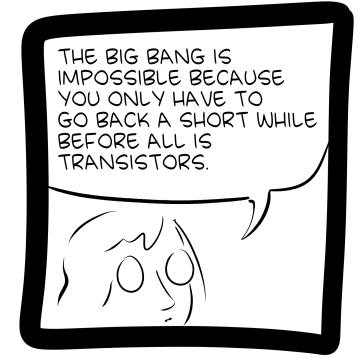
The comic takes Moore's Law -- the observation that the number of transistors on a microchip doubles roughly every two years, meaning transistors get progressively smaller -- and runs it in reverse. If transistors keep getting smaller over time going forward, then going backward they must get progressively larger. Extrapolating to 1951, a single transistor would supposedly be planet-sized, and the joke suggests this enormous transistor could be responsible for global warming.
The Humor
The humor comes from the absurdity of applying a technological trend in the wrong direction to arrive at a ludicrous conclusion. Moore's Law is an empirical observation about the pace of miniaturization in semiconductor manufacturing, not a fundamental law of physics, so extrapolating it backward is inherently silly. The comic uses this reductio ad absurdum to poke fun at how people sometimes misuse extrapolation or trend analysis to draw wildly incorrect conclusions.
There is also a layer of satire aimed at climate change denialism and pseudo-scientific explanations, as the presenter earnestly offers "giant transistors" as an alternative explanation for global temperature increases -- an explanation that is transparently absurd.
References
Moore's Law was articulated by Gordon Moore, co-founder of Intel, in 1965. He observed that the number of transistors on integrated circuits was doubling approximately every two years. This observation has held roughly true for decades and has driven the exponential growth of computing power. The comic's premise is similar to a well-known joke in computing circles about extrapolating trends beyond their valid domain.