Mortality
Explanation
The Joke
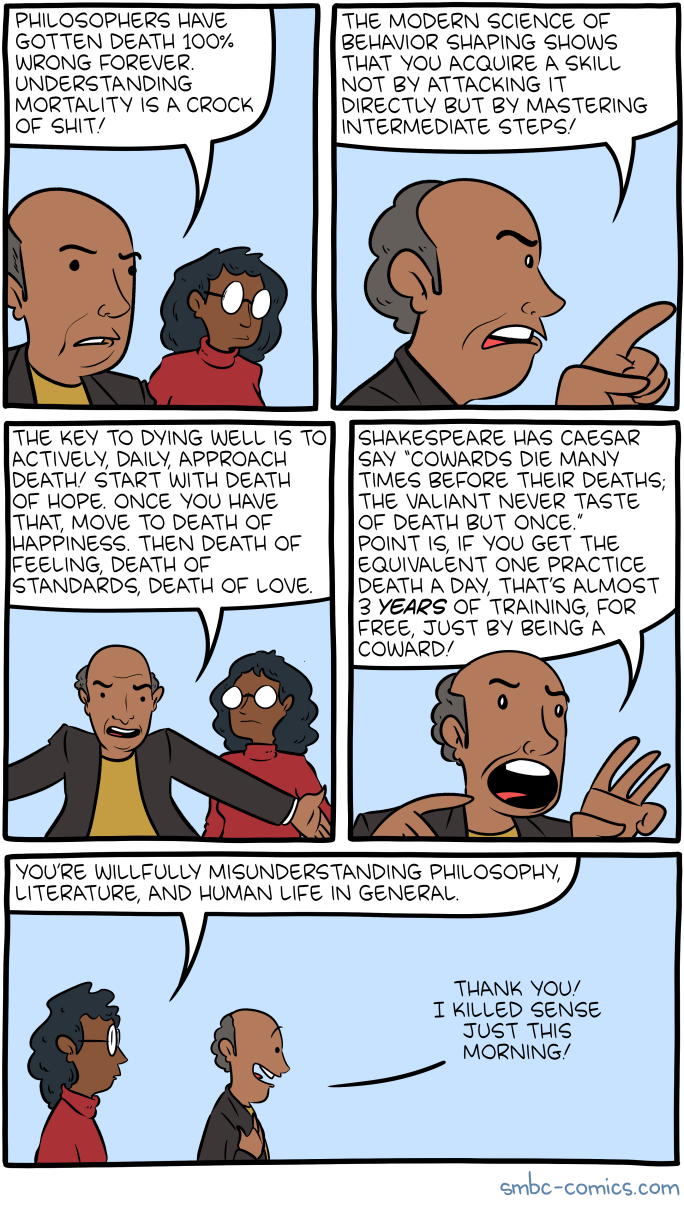
A person delivers a series of profound-sounding statements about mortality and the good life. They begin by noting that "philosophers have often dealt with understanding mortality" and claim that "the key to dying well is to actively daily approach death." They reference behavioral science and Shakespeare, arguing that one should think about death constantly to appreciate life, making each day a "small death" and finding beauty through the "standpoint of love."
In the final panel, the listener responds with cheerful obliviousness: "Thank you! I started just this morning!" -- completely misunderstanding the metaphorical advice about contemplating mortality as literal advice to start dying. The speaker is horrified, having just delivered an earnest philosophical lecture only to have it received as a how-to guide for self-destruction.
The Humor
The comedy hinges on a catastrophic misunderstanding. The speaker is offering a sophisticated synthesis of philosophical and literary thought about accepting mortality, but the listener takes it entirely at face value. The phrase "I started just this morning" is funny because it implies the listener has already begun some literal process of dying, treating the existential advice like a new exercise routine. The joke also pokes fun at the gap between intellectuals who speak in abstractions and ordinary people who interpret things literally. The speaker'''s expression of alarm in the final panel completes the gag -- their lofty philosophical framework has produced the exact opposite of its intended effect. There is also a layer of humor in the over-the-top nature of the philosophical speech itself, which name-drops Shakespeare and behavioral science while making grandiose claims about the nature of existence.
References
The comic references several philosophical traditions. The idea of "daily approaching death" echoes the Stoic practice of "memento mori" (remember that you will die), advocated by Marcus Aurelius and Seneca as a way to appreciate life. The mention of Shakespeare likely references his extensive treatment of mortality in plays like "Hamlet" ("To be or not to be") and sonnets about the passage of time. The behavioral science reference may point to Terror Management Theory (TMT), developed by Sheldon Solomon, Jeff Greenberg, and Tom Pyszczynski, which studies how awareness of mortality influences human behavior. The comic'''s philosophical speaker also echoes Martin Heidegger'''s concept of "Being-toward-death" (Sein-zum-Tode) from "Being and Time," which argues that authentic existence requires confronting one'''s own mortality.