My Imaginary Friend
Explanation
The Joke
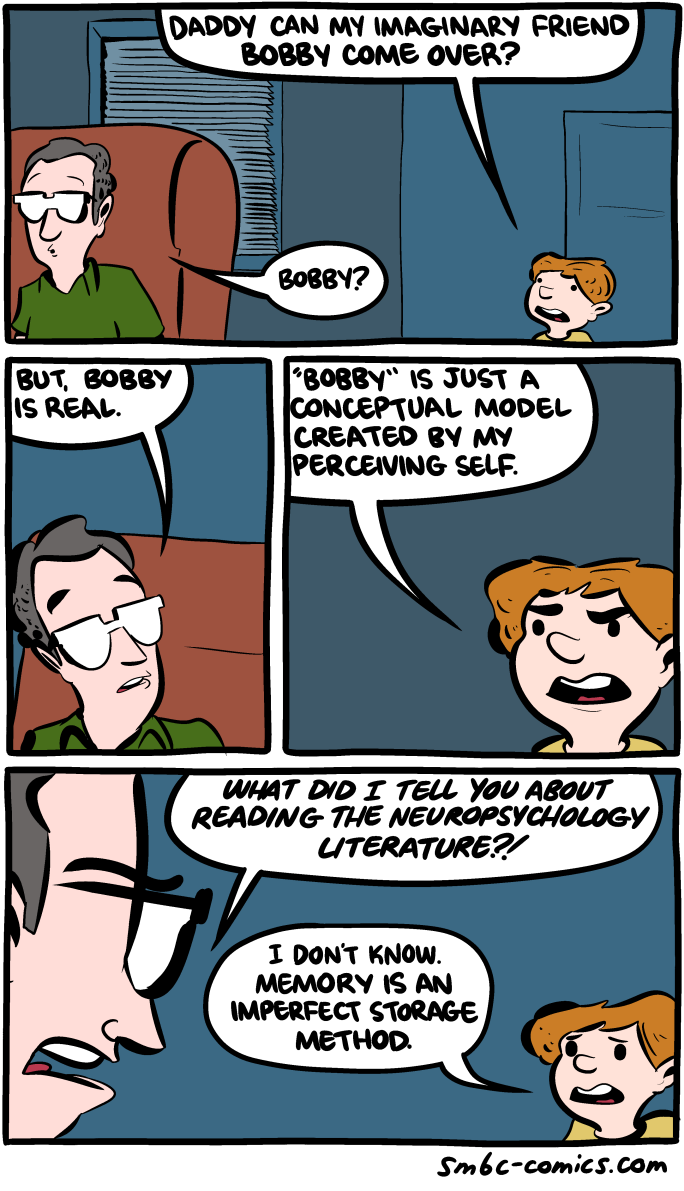
A child asks her father: "Daddy, can my imaginary friend Bobby come over?" The father, reading in his chair, asks "Bobby?" The child says "But Bobby is real." The father responds with a philosophical correction: "'Bobby' is just a conceptual model created by my perceiving self." The child then asks: "What did I tell you about reading the neuropsychology literature?!" The father sheepishly replies: "I don't know. Memory is an imperfect storage method."
The Humor
The comic inverts the typical parent-child dynamic around imaginary friends. Normally, a parent would gently explain to a child that their imaginary friend is not real. Here, the father has taken things in the opposite direction: having read neuropsychology literature, he has concluded that ALL perception is essentially a constructed model, meaning even real people like Bobby are just "conceptual models created by his perceiving self." The child, who is supposed to be the naive one, is actually the pragmatic voice of reason, scolding her father for going too far down the philosophical rabbit hole. The father's final response -- that he cannot remember her warnings because "memory is an imperfect storage method" -- doubles down on the joke by using another neuroscience insight as a convenient excuse, showing he has become insufferable with his newly acquired knowledge.
References
- The comic references neuropsychology and philosophy of mind, particularly the concept that our perception of reality is a constructed model rather than a direct experience of objective reality (a view associated with thinkers like Immanuel Kant and modern neuroscientists).
- The unreliability of memory is a well-established finding in cognitive psychology, famously studied by researchers like Elizabeth Loftus.