nanobots

Explanation
The Joke
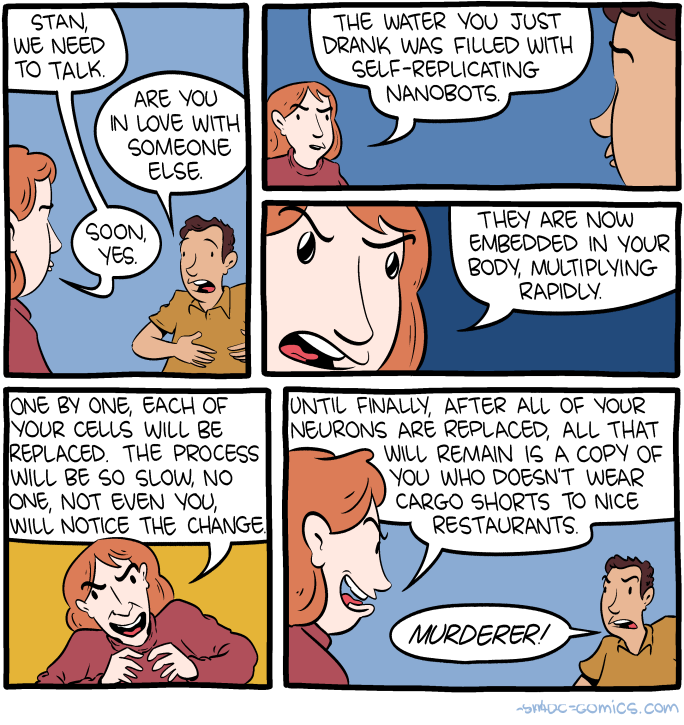
A woman tells a man that they "need to talk," and the man nervously asks if she is in love with someone else. Instead, she reveals that the water he just drank was filled with self-replicating nanobots, which are now embedded in his body and already reproducing. She explains that, one by one, each of his cells will be replaced by nanobots. Eventually, his behavior will remain the same but he will no longer be "him" -- though she reassures him that no one will notice the change. His horrified response: "Murderer!"
The comic plays on the philosophical "Ship of Theseus" problem, but applied to a romantic relationship. The woman has essentially planned to gradually replace her partner's entire biological body with nanobots, raising the question of whether the resulting entity is still the same person. The man's accusation of "Murderer!" shows he considers this gradual replacement to be equivalent to killing him, even if the end result is functionally identical.
The Humor
The humor derives from framing a classic philosophical thought experiment as a relationship conflict. The "we need to talk" opening sets up the expectation of a mundane relationship problem -- infidelity, a breakup, or some other emotional revelation. Instead, the woman has committed what might be the most elaborate and philosophically complex form of murder imaginable. The man's reaction treats it with the same emotional weight as discovering an affair, but the crime is existential annihilation via nanotechnology. There is also a dark undertone: the woman seems completely calm and matter-of-fact about having essentially killed her partner through gradual cellular replacement, and her reassurance that "no one will notice" suggests she views this as a perfectly reasonable thing to do.
References
The comic references the Ship of Theseus paradox, a thought experiment in philosophy of identity that asks whether an object that has had all of its components replaced remains fundamentally the same object. This is closely related to philosophical discussions about personal identity and consciousness, particularly in the context of mind uploading and transhumanism.