naughty
Explanation
The Joke
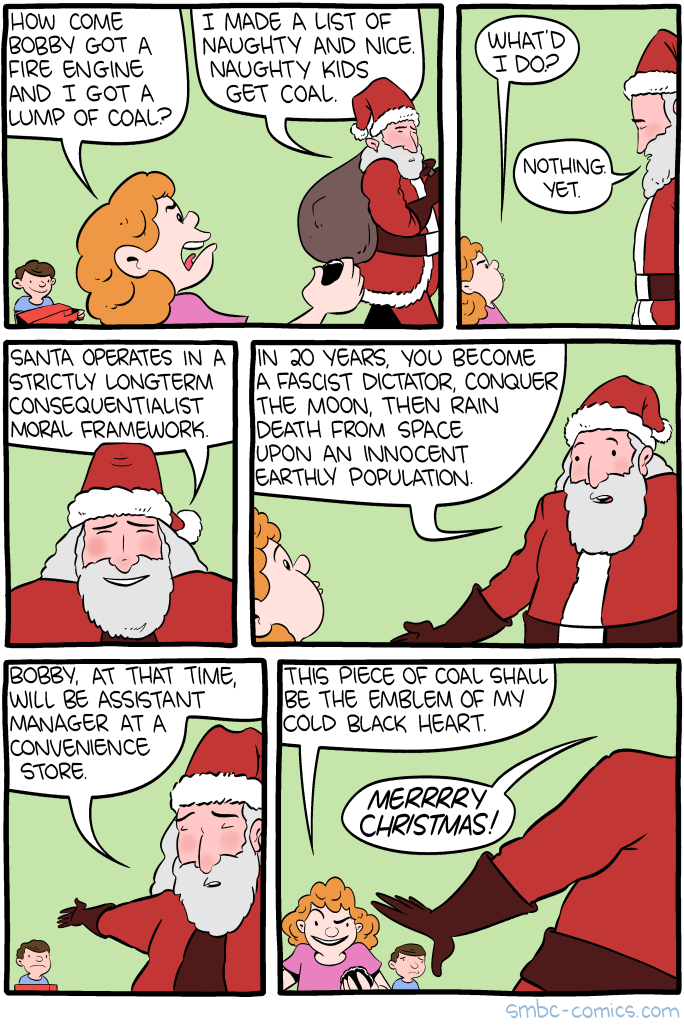
A child asks Santa Claus why Bobby got a fire engine while she only got a lump of coal. Santa explains that he made a list of naughty and nice kids, and the child asks "What'd I do?" Santa replies "Nothing yet" -- revealing that his naughty list is not based on past behavior but on future predictions. Santa then elaborates on his methodology: he operates in a "twenty-congestion consequentialist rain" framework (a play on precognitive consequentialism), explaining that in 20 years, the child will "become a highly chosen conquer the moon, then rain death from space upon an insurrection capital population." The child is horrified.
In the final panels, Santa tells his wife that this system of punishing children preemptively for future crimes will be the "emblem of my convenience" and wishes her "Merry Christmas." The comic satirizes the concept of pre-crime and predictive justice by placing it in the absurd context of Santa's naughty list.
The Humor
The comedy comes from transplanting a serious philosophical and ethical debate -- whether it is moral to punish someone for crimes they have not yet committed -- into the cheerful setting of Christmas and Santa Claus. The idea of Santa as a precognitive judge who punishes children for future war crimes is inherently absurd. The escalation is key: the child's future offense is not something minor like shoplifting but full-scale orbital bombardment of a civilian population, which is wildly disproportionate to the mundane setting of a child receiving coal. Weiner often uses holiday traditions as a vehicle for exploring dark philosophical territory, and here the juxtaposition between wholesome Christmas imagery and dystopian pre-crime ethics creates the comedic tension.
References
The concept of "pre-crime" -- punishing people for offenses they have not yet committed -- is most famously associated with Philip K. Dick's short story "The Minority Report" (1956) and its 2002 film adaptation. The comic also touches on consequentialist ethics, which judges actions by their outcomes rather than their inherent nature.