Need
Explanation
The Joke
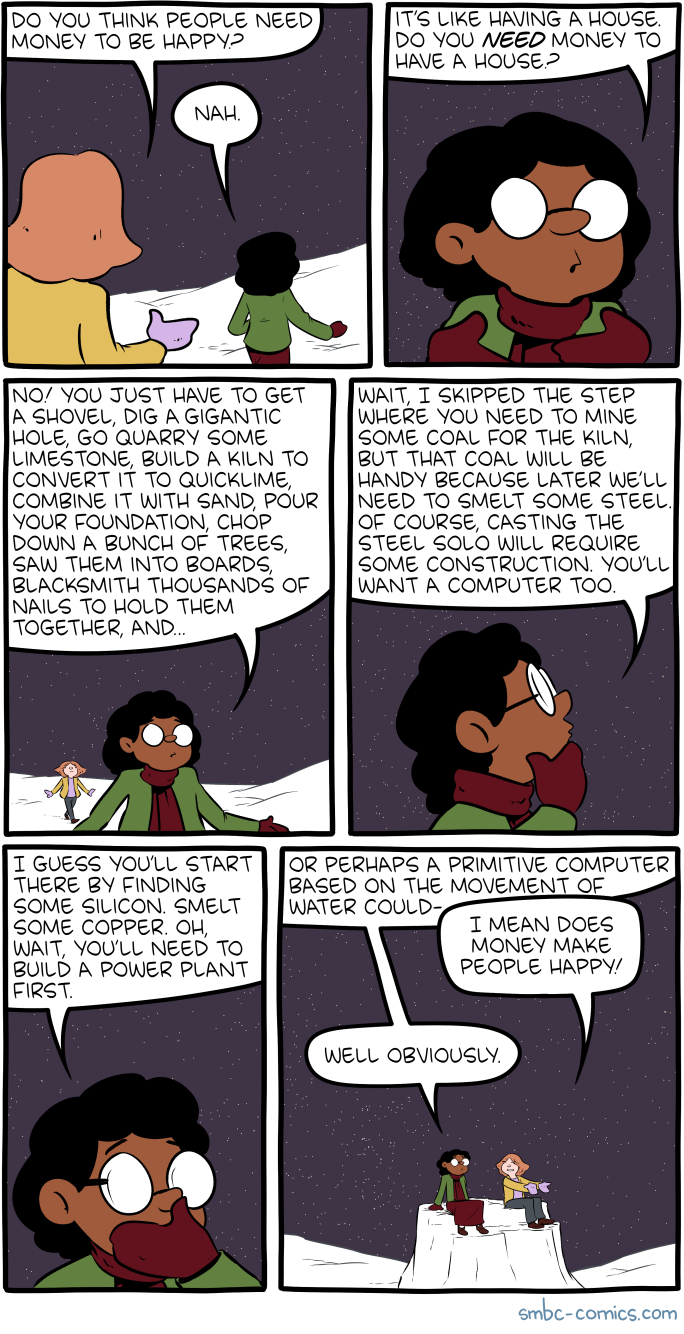
Two characters discuss whether people need money to be happy. One says "No," but then the other asks: "Do you need money to have a house?" This launches a cascade of escalating requirements. To build a house without money, you would need to "get a shovel, dig a gigantic hole, quarry some limestone, build a kiln to fire bricks," lay a foundation, smith thousands of nails, and so on. The requirements keep growing until someone points out you'd also need "a computer too" — which means you'd need to "start with some copper, smelt it, forge wires, discover semiconductors, build a power plant..." or "build a primitive computer from water and seashells."
The punchline comes when one character concludes: "I mean, does money make people happy?" and the other responds: "Well, obviously."
The Humor
The comic uses reductio ad absurdum to dismantle the popular saying "money can't buy happiness." By tracing what it would actually take to obtain basic necessities (like a house) without money, the comic reveals that money is essentially a shortcut for an impossibly complex chain of labor, resource extraction, and manufacturing. Without money, you wouldn't just need to build a house — you'd need to reinvent civilization from scratch.
The escalation is the engine of the comedy: each step in the process reveals yet another dependency, creating an ever-expanding tree of prerequisites that makes the original claim ("you don't need money") increasingly absurd. The final deadpan "Well, obviously" undercuts the entire philosophical debate by pointing out that the answer was always self-evident.
Broader Context
SMBC frequently takes popular platitudes and subjects them to rigorous logical analysis. The "money can't buy happiness" cliche is a favorite target because it sounds profound but collapses under practical examination. The comic also touches on themes of economic complexity and specialization — the implicit argument being that money is simply a tool that allows human beings to benefit from collective labor rather than doing everything themselves.