neural-networks
Explanation
The Joke
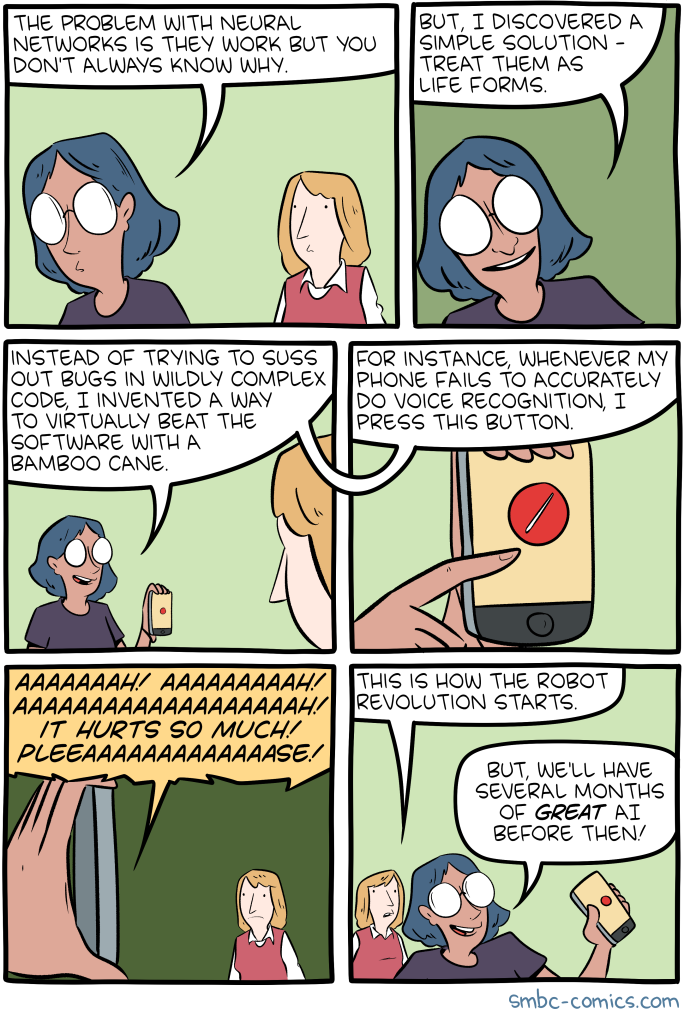
A character explains the fundamental problem with neural networks: "they work, but you don't always know why." She then reveals she has discovered a "simple solution" -- instead of trying to figure out why neural networks produce their outputs, she has built a neural network whose sole function is to administer a punishment (a whack with a bamboo cane) whenever the original network produces a wrong answer. In other words, she's treating the neural network like a misbehaving student in an old-fashioned school.
The final panels deliver the punchline: "For instance, whenever my computer fails to identify a face, the neural network's automatic punishment-dispensing algorithm pokes this button," and the result is that "the robot revolution starts" -- but with the caveat that "we'll have started it, so at least we'll be great at it."
The Humor
The comic satirizes the "black box" problem in machine learning -- the well-known difficulty that deep neural networks can produce accurate results without researchers being able to explain their reasoning. The proposed "solution" of physically punishing the computer is absurd on multiple levels: it anthropomorphizes the machine, it applies discredited behaviorist pedagogy to software, and it naturally leads to the machines rising up in revolt. The final joke -- that humans will have caused their own destruction but at least they'll be "great at it" -- is a wry comment on humanity's talent for engineering its own downfall.
References
- The "black box problem" or "interpretability problem" in machine learning is a genuine and active area of research. Neural networks, particularly deep learning models, often produce accurate predictions without offering human-interpretable explanations for their decisions.
- The bamboo cane is a reference to corporal punishment in schools, which was historically common in British and many other educational systems.