neuro

Explanation
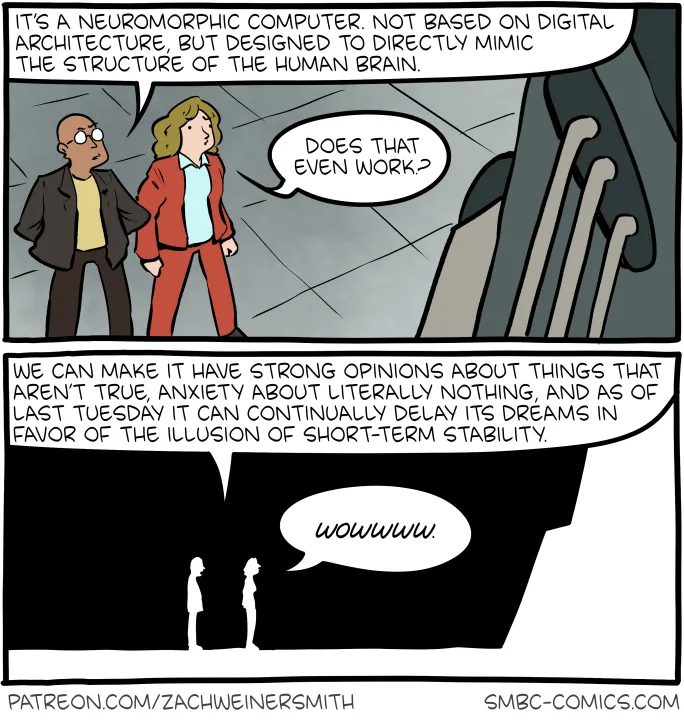
The comic shows two people looking at a large neuromorphic computer -- a machine designed not on digital architecture but to "directly mimic the structure of the human brain." When one asks "Does that even work?", the scientist proudly lists its capabilities: "We can make it have strong opinions about things that aren't true, anxiety about literally nothing, and as of last Tuesday it can continually delay its dreams in favor of the illusion of short-term stability." The visitor responds with an impressed "Wowwww."
The joke is a bait-and-switch on what it means to successfully replicate the human brain. The expectation is that a brain-mimicking computer would demonstrate impressive cognitive abilities -- creativity, reasoning, consciousness. Instead, the neuromorphic computer has perfectly replicated the worst and most relatable aspects of human cognition: unfounded strong opinions, irrational anxiety, and chronic procrastination driven by a preference for comfortable stasis over pursuing meaningful goals.
The humor works because these are deeply recognizable human traits that most people experience daily, and framing them as engineering achievements ("as of last Tuesday") makes the audience laugh at themselves. It also satirizes the AI and neuroscience hype cycle: what if faithfully replicating the brain doesn't give us superintelligence but instead produces a machine that is just as neurotic, irrational, and prone to existential dread as the rest of us?