neuron

Explanation
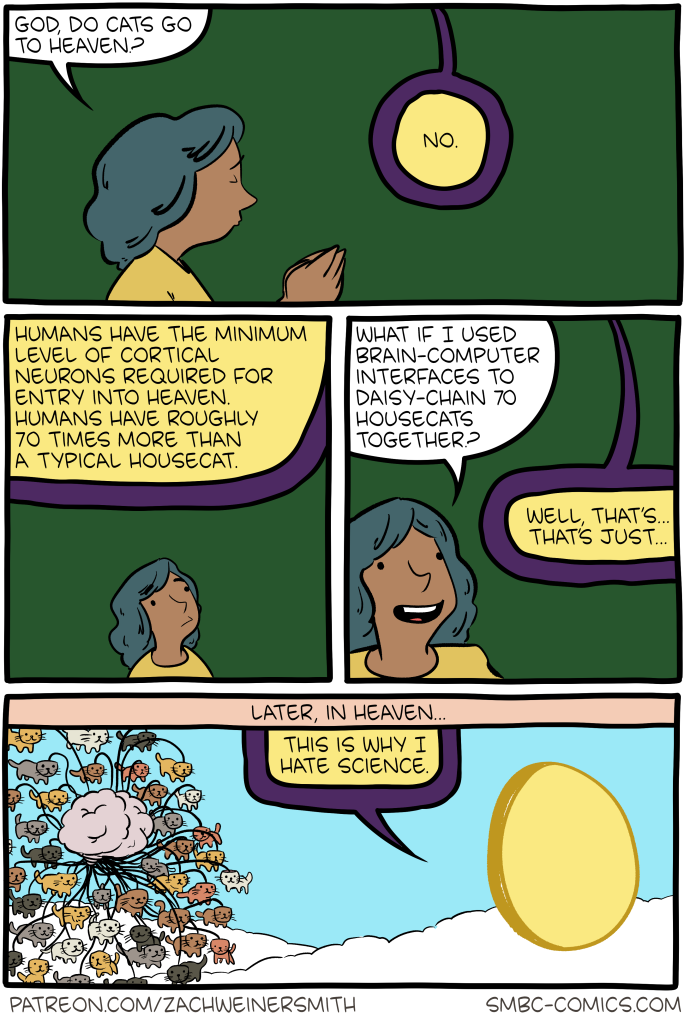
This comic features a woman praying to God, asking whether cats go to heaven. God (depicted as a glowing orb) flatly says "No."
God then elaborates with a darkly specific theological rule: humans have the minimum level of cortical neurons required for entry into heaven, and humans have roughly 70 times more cortical neurons than a typical housecat. This frames the afterlife as having a bureaucratic, quantitative threshold -- like a minimum height requirement for a roller coaster, but for your soul.
The woman, being a resourceful scientist-type, immediately spots the loophole: "What if I used brain-computer interfaces to daisy-chain 70 housecats together?" This would, in theory, create a networked cat-brain with human-equivalent cortical neuron count, thus meeting the admission threshold.
God starts to respond "Well, that's... that's just..." clearly flustered and unable to find a good objection. In the final panel, captioned "Later, in heaven," we see the woman smiling beatifically alongside what appears to be a massive tangle of daisy-chained cats (now in heaven), while God says "This is why I hate science."
The humor comes from several places. First, there is the absurdity of heaven having a specific neuron-count requirement, reducing the profound theological question of animal souls to a quantitative engineering problem. Second, the woman's response is a perfect parody of how scientists and engineers approach constraints -- not as philosophical limits but as technical problems to be solved with creative workarounds. Third, God's exasperated "This is why I hate science" perfectly captures the recurring SMBC theme of science finding loopholes in divine rules. The comic also plays on real neuroscience: the cortical neuron counts are roughly in the right ballpark, with humans having around 16 billion cortical neurons compared to a cat's roughly 250 million (a ratio of about 64x, close to the 70x cited).