neuroses
Explanation
The Joke
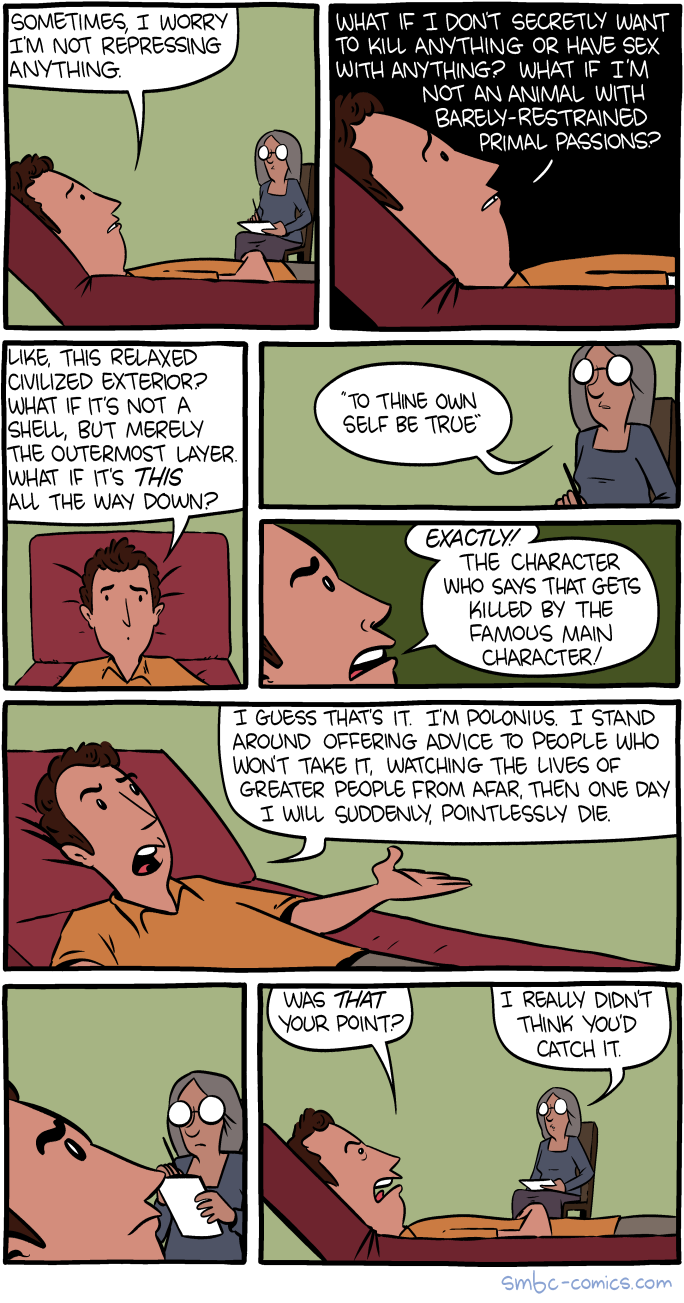
A man is lying on a therapist's couch expressing an unusual anxiety: he worries that he is not repressing anything. He frets that he does not secretly want to kill anyone or have sex with anything, and that he might not be an animal with barely-restrained primal passions. He worries that his relaxed, civilized exterior is not a shell, but merely the outermost layer -- and that "this is it all the way down."
The therapist responds with the Shakespeare quote "To thine own self be true," and the patient immediately identifies the source: Polonius from Hamlet, "the character who says that gets killed by the famous main character." He then spirals further into despair, concluding that he is Polonius -- a person who stands around offering advice to people who will not take it, watches the lives of greater people from afar, and will one day suddenly and pointlessly die. The therapist, stunned, asks "Was THAT your point?" and admits, "I really didn't think you'd catch it."
The Humor
The comic works by inverting the typical therapy scenario. Instead of a patient anxious about their repressed desires, this patient is anxious about the absence of repressed desires -- he's neurotic about not being neurotic enough. This is a meta-joke about Freudian psychology, which assumes everyone has hidden depths of primal urges; the patient fears being boringly well-adjusted.
The second layer of the joke comes when the therapist's attempt at comfort backfires spectacularly. The quote "To thine own self be true" is often used as uplifting self-help wisdom, but the patient correctly notes that in Hamlet, it is spoken by Polonius -- a bumbling, long-winded character whom Hamlet kills almost accidentally while he hides behind a curtain. The patient's identification with Polonius is both hilariously self-deprecating and literarily astute. The therapist's shocked final line reveals she was actually testing him (or making a subtle point about his insignificance) and did not expect him to decode the unflattering implication.
References
The comic references Shakespeare's "Hamlet," specifically the character Polonius, who delivers the famous line "To thine own self be true" (Act 1, Scene 3). Polonius is a courtier who dispenses advice freely but is generally regarded as pompous and meddling. He is killed by Hamlet in Act 3 when Hamlet stabs through a curtain behind which Polonius is hiding. The comic also plays on Freudian psychoanalytic theory, which posits that humans repress primal drives (particularly sexual and aggressive urges) beneath a veneer of civilization.