new-word
Explanation
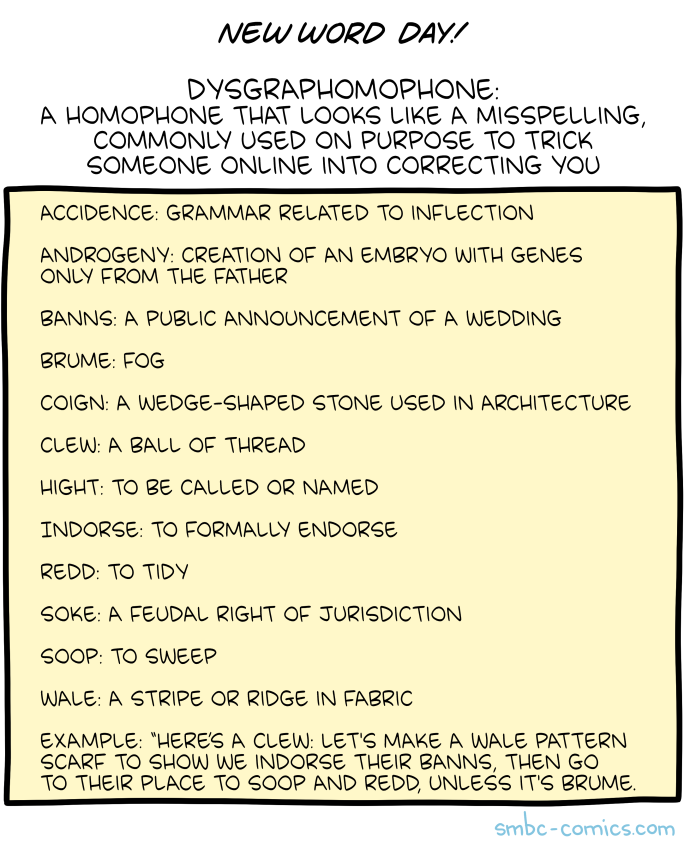
This comic presents a fake "New Word Day" educational page that defines the word "dysgraphuophone" -- supposedly "a homophone that closely resembles a misspelling, commonly used on purpose to trick someone online into calling you uneducated."
Below the definition, the comic lists several pairs of words that look like misspellings but are actually real, legitimate English words with different meanings from their more common homophones or near-homophones. These include terms like "androgenous" (relating to producing male offspring, as distinct from "androgynous"), "banns" (a public announcement of a wedding, not a misspelling of "bans"), "brumal" (relating to winter), "quoin" (a wedge-shaped stone in architecture, not a misspelling of "coin"), "endorse" vs. "indorse" (both legitimate spellings), "gybe" (a sailing term, not a misspelling of "jibe"), "hale" (a stripe or ridge in fabric, distinct from "hail"), and "goop" (to gaze, giving a more dignified reading to the brand name).
The humor is multilayered. First, the made-up word "dysgraphuophone" is itself an impressively plausible-sounding linguistic term, constructed from Greek roots (dys- meaning bad, grapho- meaning writing, phone- meaning sound). Second, the comic is essentially a weaponized vocabulary lesson -- it gives readers ammunition to use obscure but real words online and then smugly correct anyone who calls them out. Third, it satirizes internet culture where people rush to correct others' spelling, revealing that the "corrector" is often the less knowledgeable party.
The comic appeals to the particular SMBC audience of people who enjoy learning obscure facts and then deploying them to make others feel foolish.