newton
Explanation
The Joke
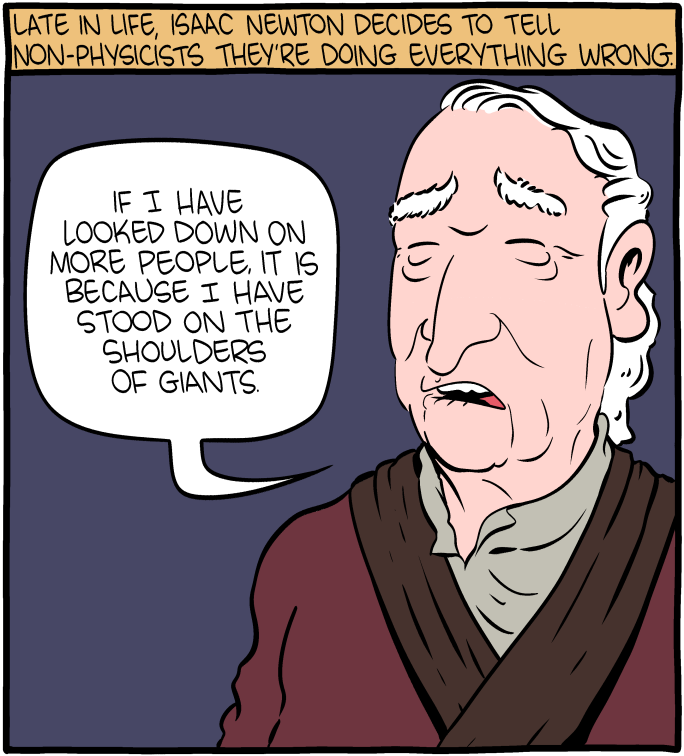
The caption reads: "Late in life, Isaac Newton decides to tell non-physicists they're doing everything wrong." Newton is shown smugly declaring, "If I have looked down on more people, it is because I have stood on the shoulders of giants." This is a twist on Newton's famous quote, "If I have seen further, it is by standing on the shoulders of giants," which is traditionally understood as a humble acknowledgment that his scientific achievements built upon the work of earlier thinkers.
In the comic's version, Newton replaces "seen further" with "looked down on more people," transforming a statement of intellectual humility into one of arrogant condescension. The modified quote implies that Newton used the accumulated knowledge of his predecessors not to advance understanding, but to elevate himself above ordinary people and sneer at them from a greater height.
The Humor
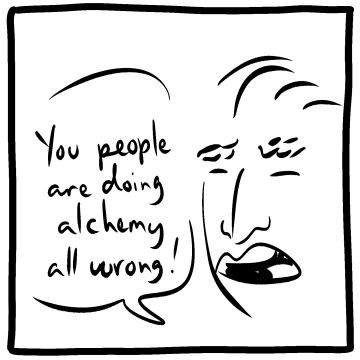
The joke works on multiple levels. First, it plays on the well-known original quote, so the substitution is immediately recognizable and funny. Second, it satirizes a real tendency among some scientists and academics to use their expertise as a cudgel, treating non-specialists with contempt rather than sharing knowledge generously. The caption's framing -- Newton deciding to "tell non-physicists they're doing everything wrong" -- perfectly captures the stereotype of the insufferable expert. There is also a historical layer: the real Newton was, by many accounts, genuinely difficult and arrogant, making this fictional version feel plausible.
References
The original quote, "If I have seen further, it is by standing on the shoulders of giants," comes from a 1675 letter Newton wrote to Robert Hooke. Scholars have debated whether even the original was genuinely humble or a veiled insult, since Hooke was notably short.