Nietzsche
Explanation
The Joke
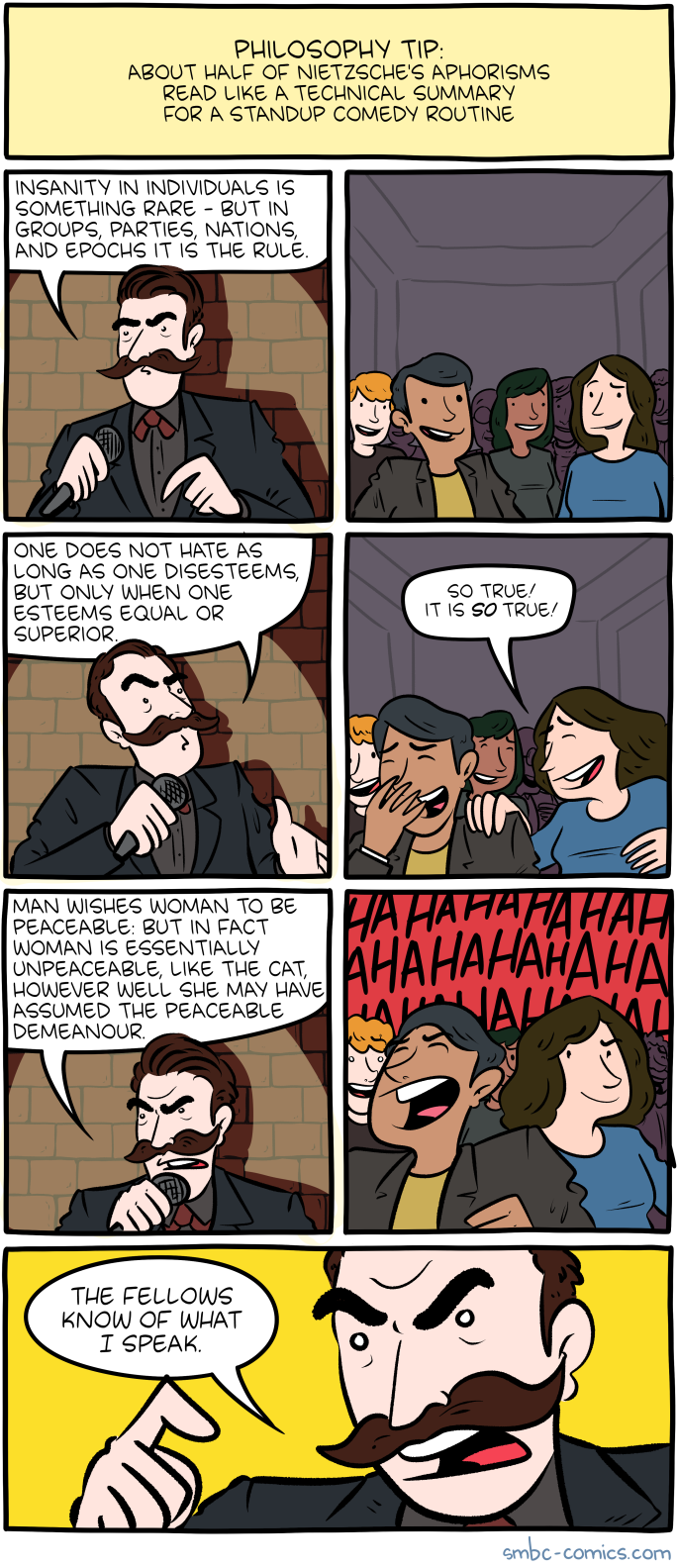
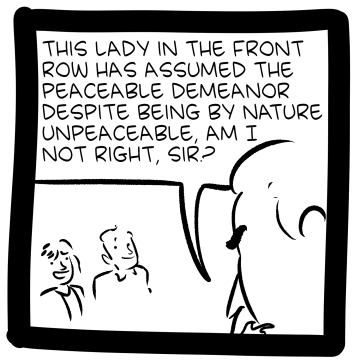
The comic opens with a "Philosophy Tip" header stating that about half of Nietzsche's aphorisms read like a technical summary for a standup comedy routine. It then presents three actual Nietzsche quotes to an audience: "Insanity in individuals is something rare -- but in groups, parties, nations, and epochs, it is the rule," "One does not hate as long as one disesteems, but only when one esteems equal or above oneself," and "Man wishes woman to be peaceable, but in fact woman is essentially unpeaceable, like the cat, however well she may have assumed the peaceable demeanor." Each quote gets progressively bigger laughs from the audience, culminating in uproarious laughter and applause.
The final panel shows a performer on stage delivering Nietzsche's aphorisms as if they were standup comedy bits, with the audience in stitches. A figure in the corner notes, "The fellow knows of what I speak."
The Humor
The humor works on two levels. First, there is a genuine observation that many of Nietzsche's pithy statements do have the structure of observational comedy -- they set up a common expectation and then subvert it with a sharp, often cynical punchline. Read aloud to a crowd, stripped of their philosophical context, they really could pass as comedy material. Second, the comic is funny because of the absurd image of performing dense 19th-century German philosophy as a standup routine and having it absolutely kill with the audience. The crowd reacts as if they are watching a top comedian rather than attending a philosophy lecture.
References
The quotes are drawn from Friedrich Nietzsche's works. The first is from "Beyond Good and Evil" (1886), aphorism 156. The third quote, about women being "unpeaceable, like the cat," is also from "Beyond Good and Evil." Nietzsche (1844-1900) was a German philosopher known for his provocative, aphoristic writing style, which lends itself to the comic's premise.