numbers-2
Explanation
The Joke
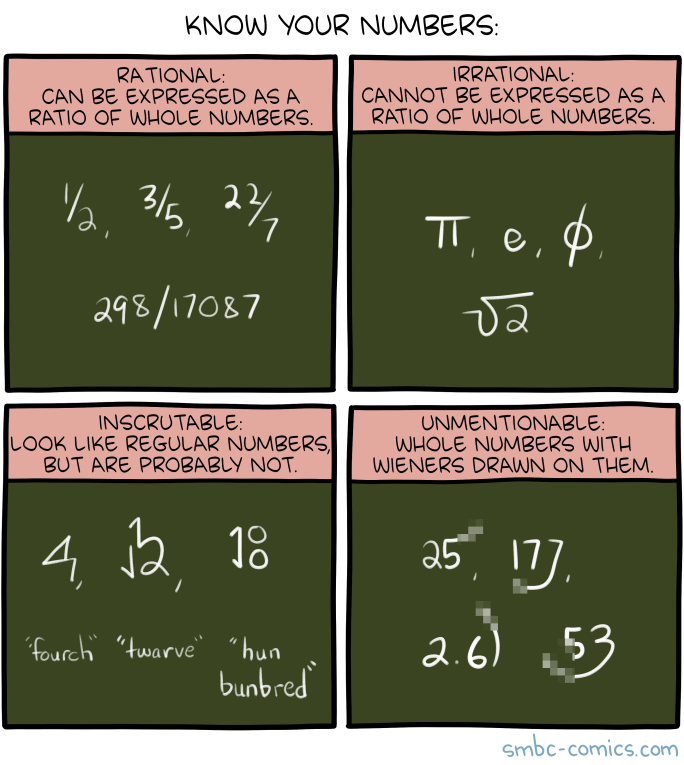
The comic is titled "Know Your Numbers" and presents a four-quadrant educational chart, styled like a classroom chalkboard. The first two quadrants are legitimate math categories: "Rational" numbers (which can be expressed as a ratio of whole numbers, with examples like 1/2, 3/5, 22/7, and 298/17087) and "Irrational" numbers (which cannot be expressed as such a ratio, with examples like pi, e, phi, and the square root of 2). These are real mathematical definitions.
Then the chart goes off the rails. The third quadrant introduces "Inscrutable" numbers -- ones that "look like regular numbers but are probably not," with examples like 4, 12, and 18 written in a shaky, suspicious-looking handwriting, labeled with phonetic misspellings like "fourch," "twarve," and "hun bunbred." The fourth quadrant presents "Unmentionable" numbers -- "whole numbers with wieners drawn on them," showing numbers like 25, 17, 26, and 53 with crude phallic doodles added to them.
The Humor
The comic starts with a format that looks like a genuine educational reference, which makes the descent into absurdity in the bottom half all the funnier. The "Inscrutable" numbers parody the experience of encountering handwriting so bad that you cannot tell what number someone wrote -- the phonetic misspellings suggest someone trying to read these numbers aloud and failing. The "Unmentionable" category is pure juvenile humor elevated by its placement in an otherwise academic context: the idea that there exists a formal mathematical classification for "numbers with wieners drawn on them" is funny precisely because of how seriously the format presents it. The comic plays on the way math education categorizes numbers into increasingly abstract classes, suggesting that the taxonomy could continue into territory that is less rigorous and more juvenile.