Oak
Explanation
The Joke
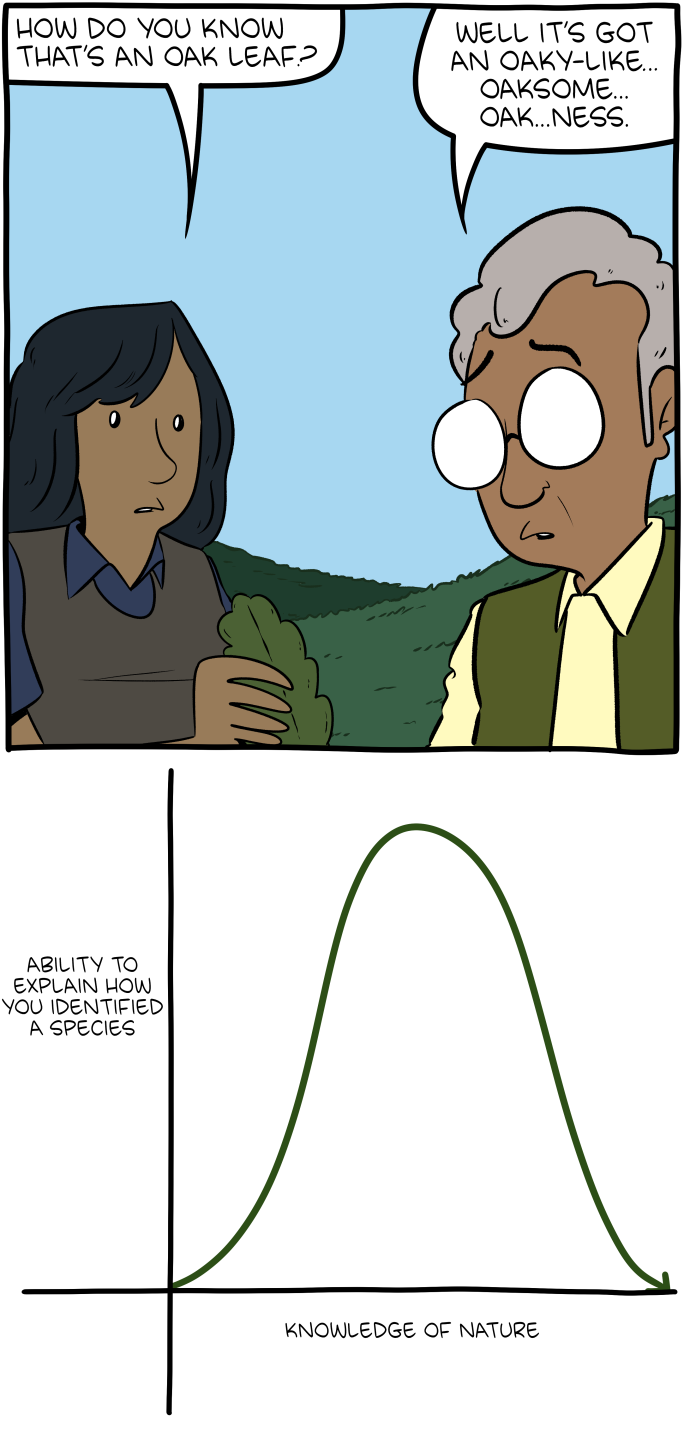
A woman holds up an oak leaf and asks a man how he knows it is an oak leaf. He stumbles through a non-answer: "Well it's got an oaky-like... oaksome... oak...ness." He clearly recognizes the leaf on sight but cannot articulate the specific features that make it identifiable as oak. Below the dialogue, a graph shows a bell curve plotting "Ability to explain how you identified a species" against "Knowledge of nature." The curve shows that people with very little knowledge cannot explain identification (they do not know anything), people with moderate knowledge can explain it well (they have learned the distinguishing features), and people with extensive knowledge once again cannot explain it (their recognition has become so intuitive that they have lost access to the explicit reasoning).
The Humor
The comic illustrates a well-known phenomenon in expertise: the transition from conscious competence to unconscious competence. A beginner cannot identify an oak leaf at all. An intermediate naturalist can say "it has rounded lobes and a certain vein pattern." But a true expert has internalized identification so deeply that it has become automatic pattern recognition, and when asked to explain, they are reduced to sputtering "it just looks... oaky." This is a universal experience across many domains -- experts often struggle to articulate knowledge that has become second nature. The bell-curve graph is a classic SMBC move, using a pseudo-academic chart to formalize a humorous observation about human cognition.
References
This comic relates to the concept of the "Dunning-Kruger effect" in reverse, as well as the psychological distinction between explicit and implicit knowledge. It also touches on the philosophical problem of tacit knowledge, famously described by Michael Polanyi, who argued that "we can know more than we can tell."