Old

Explanation
The Joke
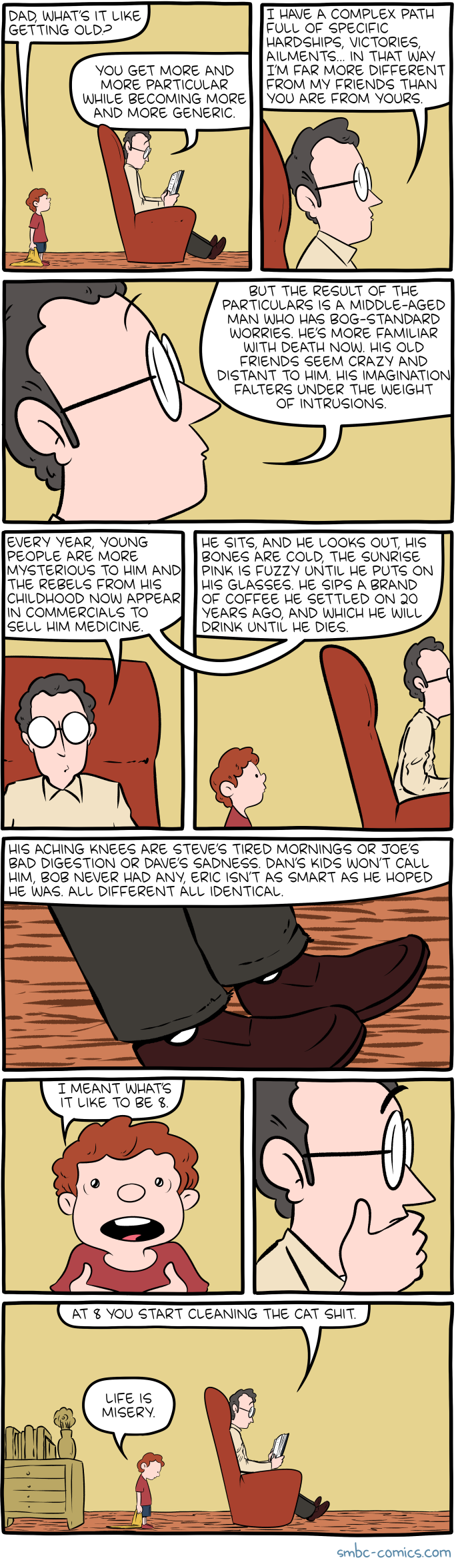
A child asks their father, "Dad, what's it like getting old?" The father begins what seems like a philosophical reflection: "You get more and more particular about smaller and smaller things." He then elaborates at length about how a middle-aged man might become very particular about increasingly trivial matters -- his specific morning routine, his preferences for very particular things, becoming resistant to change and new experiences.
The father explains how young people are adaptable and open to anything, but as you age, your world narrows. Evenings are cold, mornings are for coffee. He describes a man who settled on specific routines -- 20 pages of reading before bed -- and kept those routines until he died. Then he adds: "Excluding American-style joking about aging, inspection of senior citizens' daily lives reveals that old age is not that different. Kids don't call as much, it's harder to maintain dignity as we age."
When asked "What's it like?" the father delivers the final line: "Life is..." with a child responding "At 6 you start cleaning the cat box" -- bringing the grand philosophical meditation crashing back to mundane reality.
The Humor
The comic builds an elaborate, almost literary meditation on aging -- the narrowing of horizons, the increasing specificity of preferences, the slow calcification of routine. It reads like something from a reflective essay or memoir. But the punchline deflates all of this grandiosity by cutting back to the immediate domestic reality: the father was apparently just trying to get his kid to do chores. The contrast between the sweeping existential reflection and the mundane parental task of assigning cat litter duty is the core joke. The comic also subtly comments on how discussions about aging tend to become self-indulgent philosophical monologues.
References
The comic touches on genuine gerontological and psychological observations about aging, including the narrowing of social circles, increased routine rigidity, and the preference for familiar experiences -- concepts related to socioemotional selectivity theory developed by psychologist Laura Carstensen.