On the Topic of Early Birds and Worms
Explanation
The Joke
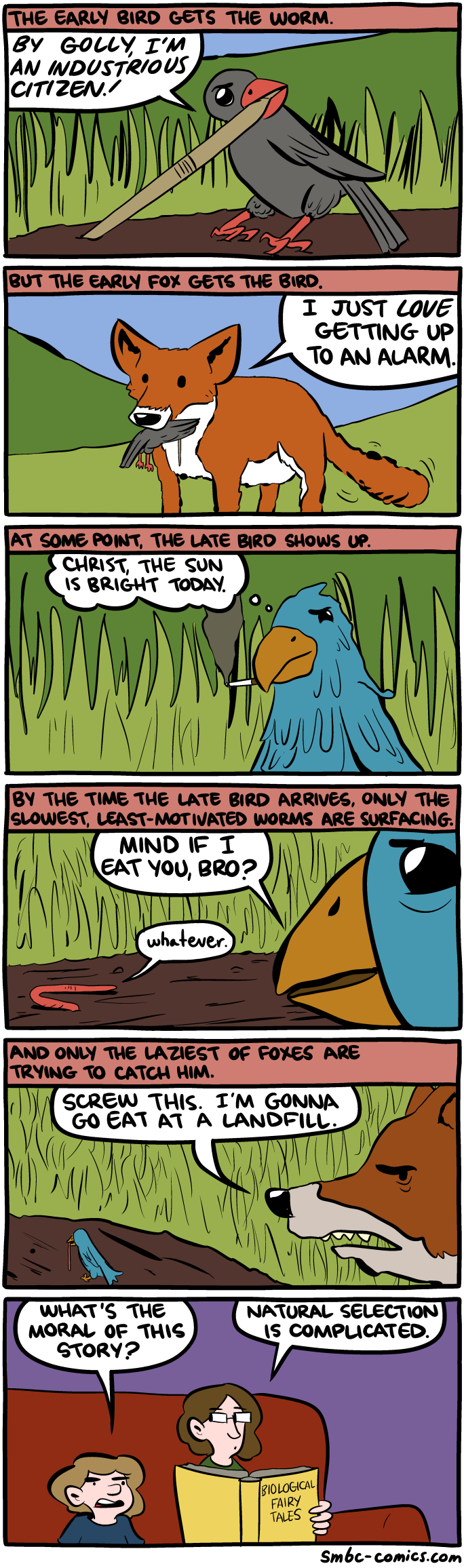
The comic plays out the proverb "the early bird gets the worm" as a full ecological scenario. The early bird proudly gets the worm ("By golly, I'm an industrious citizen!"). But then the early fox gets the bird ("I just love getting up to an alarm"). At some point, the late bird shows up ("Christ, the sun is bright today"). By the time the late bird arrives, only the slowest, least-wanted worms are left, and the worms don't even care about being eaten ("Mind if I eat you, bro?" "Whatever..."). And only the laziest of foxes are trying to catch them ("Screw this. I'm gonna go eat at a landfill"). A child reading a book asks, "What's the moral of this story?" and the answer is: "Natural selection is complicated."
The Humor
The comic deconstructs the simplistic moral of "the early bird gets the worm" by following the ecological logic to its natural conclusion. Yes, the early bird gets the worm -- but the early bird also gets eaten by the early fox. Meanwhile, the late bird finds only pathetic worms but also faces no predators. The joke reveals that the proverb's seemingly straightforward lesson about the virtue of industriousness falls apart when you consider the full complexity of an ecosystem. Being "early" and industrious puts you at risk from other industrious creatures higher up the food chain. The lazy worms survive, the lazy birds survive, and even the lazy foxes give up and find easier food. The punchline -- "Natural selection is complicated" -- is a wry acknowledgment that pithy moral lessons rarely capture the actual complexity of nature (or life). It's a classic SMBC move of applying scientific thinking to folk wisdom and finding the wisdom wanting.