orbit
Explanation
The Joke
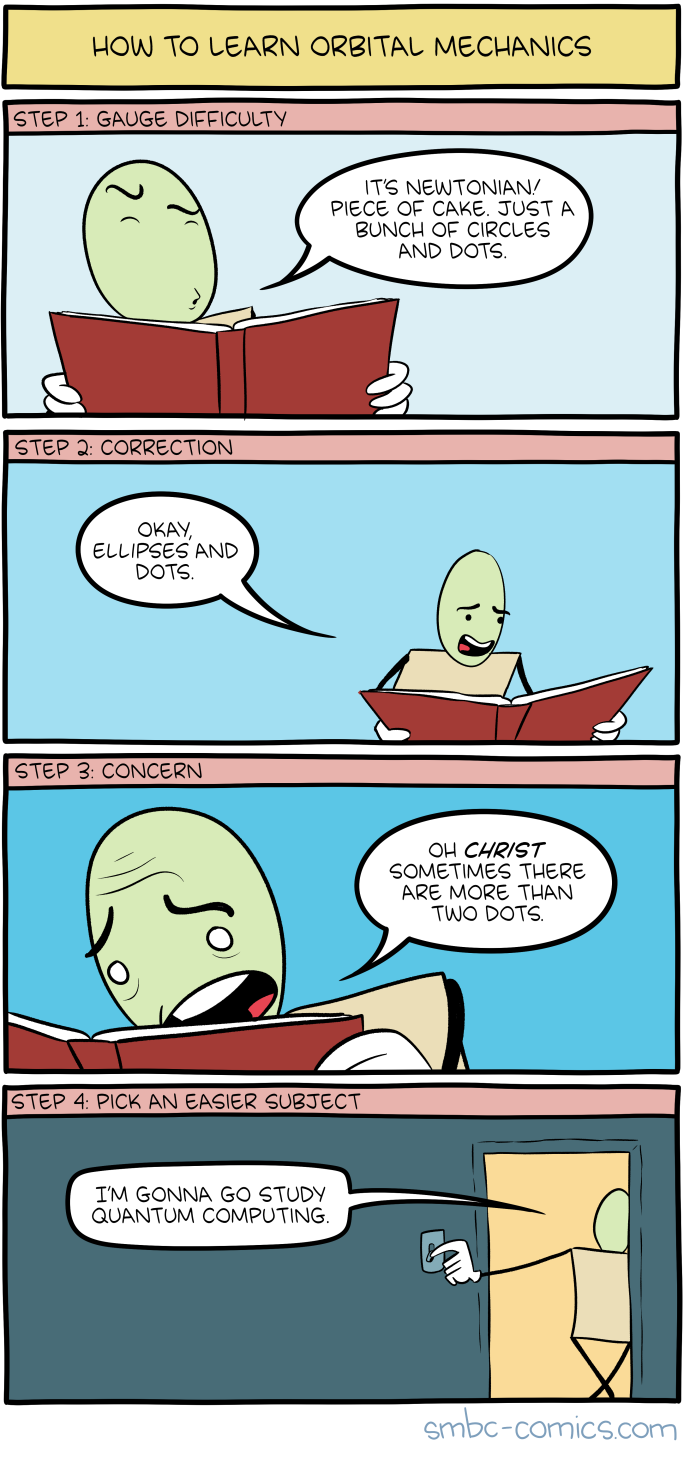
The comic is titled "How to Learn Orbital Mechanics" and follows a student through escalating stages of distress. In Step 1, "Gaudy Optimism," the student declares orbital mechanics is "Newtonian! Piece of cake. Just a bunch of circles and dots." Step 2, "Correction," notes it is actually "ellipses and dots." Step 3, "Concern," introduces the alarming revelation: "Oh crap! Sometimes there are more than two dots." Step 4, the final stage, shows the student declaring: "I'm gonna go study quantum computing" -- fleeing to an entirely different (and arguably harder) field rather than deal with the n-body problem.
The joke traces the classic trajectory of someone learning orbital mechanics. It starts simple -- Newtonian gravity, circular orbits, two bodies -- and then reality sets in. The correction from circles to ellipses is minor, but the real horror arrives when you realize real orbital mechanics involves more than two bodies interacting simultaneously (the n-body problem), which has no general closed-form solution and is one of the great unsolved problems in classical mechanics. The student's response is to flee to quantum computing, implying that quantum mechanics feels easier by comparison.
The Humor
The humor is in the escalating panic and the absurd final escape. Each step strips away a layer of false confidence, and the punchline -- running away to quantum computing -- is funny because quantum computing is itself notoriously difficult, yet the student perceives it as preferable to confronting the n-body problem. The comic captures a real experience in physics education: the moment you realize that the "simple" Newtonian mechanics you learned in introductory courses becomes nightmarishly complex once you move past idealized two-body systems.
References
The n-body problem -- predicting the motion of three or more objects interacting gravitationally -- is famously intractable. While the two-body problem has a clean analytical solution (Kepler orbits / ellipses), adding even one more body makes the system chaotic and generally unsolvable in closed form. This has been known since Poincare's work in the late 19th century.