origin
Explanation
The Joke
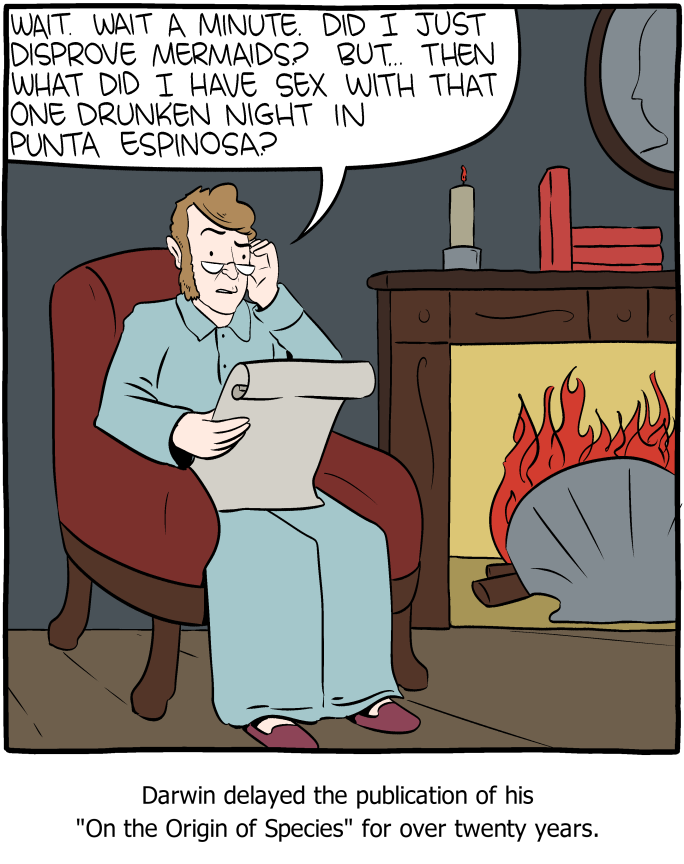
A man is sitting in an armchair reading a book, and suddenly has a panicked realization: "Wait, wait a minute. I just disproved abiogenesis! But then what did I have sex with that one drunken night in Santa Espinoza?!" The caption below reads: "Darwin delayed the publication of his 'On the Origin of Species' for over twenty years."
The comic imagines a humorous (and fictional) reason for why Charles Darwin famously delayed publishing his theory of evolution. The real Darwin did indeed wait over two decades before publishing "On the Origin of Species" (1859), and historians typically attribute this to his fear of public and religious backlash, his desire to accumulate more evidence, and his concern about the implications of the theory. The comic instead suggests that Darwin delayed because disproving abiogenesis (the theory that life can arise from non-living matter, also known as "spontaneous generation") raised uncomfortable personal questions about a mysterious sexual encounter he had.
The Humor
The humor is thoroughly absurd and works on multiple levels. First, it takes a real historical mystery (why did Darwin delay publication?) and provides a hilariously inappropriate personal explanation. Second, the logic is intentionally garbled -- Darwin's actual work was on evolution by natural selection, not on disproving abiogenesis (that was more Louis Pasteur's domain). The confused science makes the panic even funnier. Third, the implication that Darwin had a drunken encounter with something he now realizes could not have been a spontaneously generated life form is left tantalizingly unexplained, which makes it funnier than any specific answer could be.
References
Charles Darwin completed an initial manuscript of his evolutionary theory by 1842 but did not publish "On the Origin of Species" until 1859, prompted partly by Alfred Russel Wallace independently arriving at similar conclusions. Abiogenesis -- the natural process of life arising from non-living matter -- is distinct from spontaneous generation, which was disproved by experiments like those of Louis Pasteur in 1859.