other-riddles-of-the-sphinx
Explanation
The Joke
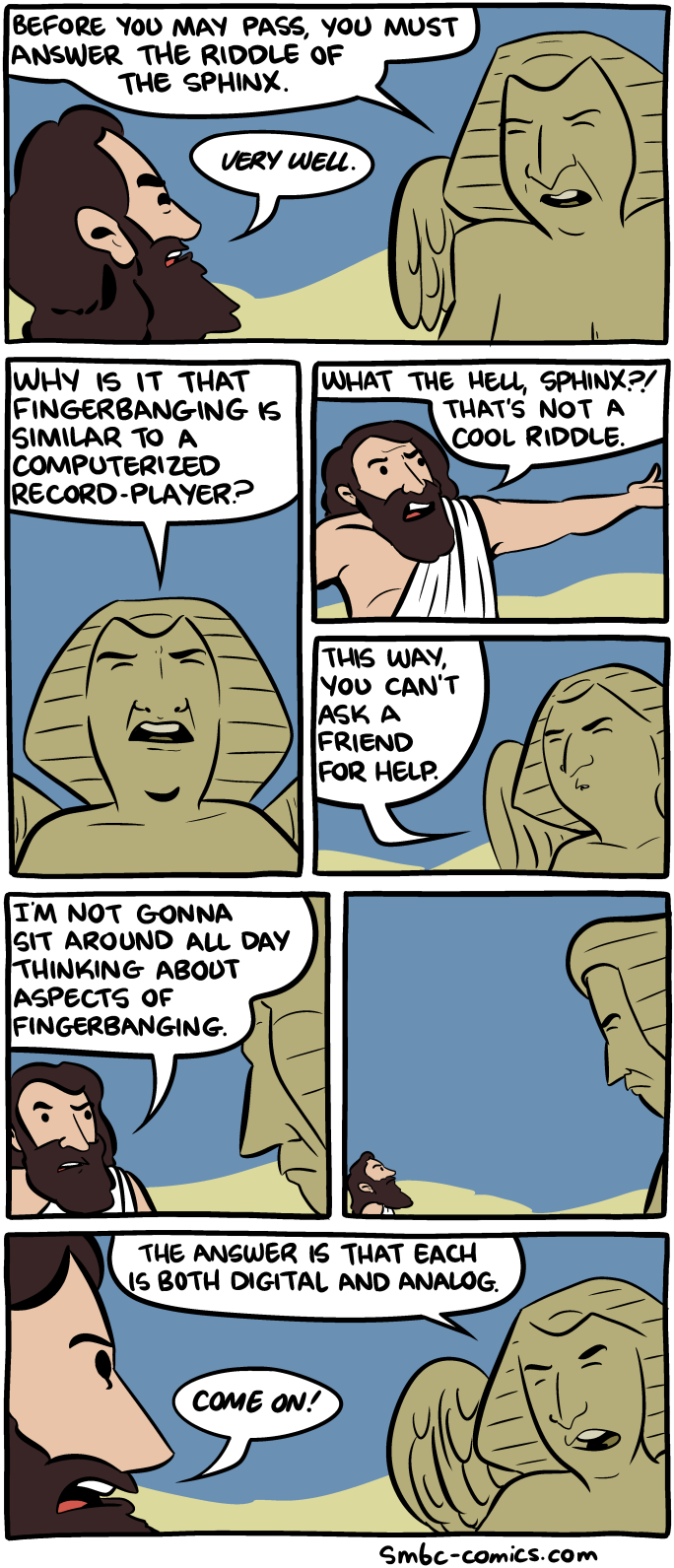
A traveler approaches the Sphinx, who declares, "Before you may pass, you must answer the riddle of the Sphinx." The traveler agrees enthusiastically. But instead of the classic riddle, the Sphinx asks: "Why is it that fingerbanging is similar to a computerized record player?" The traveler objects that this isn''t a cool riddle, and the Sphinx warns that he can''t ask a friend for help. The traveler protests that he''s not going to sit around all day thinking about aspects of fingerbanging. The Sphinx then reveals the answer: "The answer is that each is both digital and analog." The traveler exclaims, "Come on!"
The Humor
The comic plays on the double meaning of the word "digital." In technology, "digital" refers to electronic/computerized systems (as opposed to analog), while in anatomy, "digital" relates to fingers (from the Latin "digitus" meaning finger). The Sphinx''s riddle is a crude pun: fingerbanging is "digital" in the anatomical sense (involving fingers) and a computerized record player is "digital" in the technological sense, while both also have "analog" counterparts (manual/physical). The humor comes from the contrast between the mythic gravitas of the Sphinx demanding a riddle and the lowbrow, juvenile pun it actually delivers. The traveler''s frustration mirrors the audience''s likely groan at the pun.
References
In Greek mythology, the Sphinx guarded the entrance to the city of Thebes and asked travelers a riddle: "What walks on four legs in the morning, two legs at noon, and three legs in the evening?" The answer is a human (crawling as a baby, walking upright as an adult, and using a cane in old age). Those who failed to answer were devoured. Oedipus famously solved the riddle.