paradox
Explanation
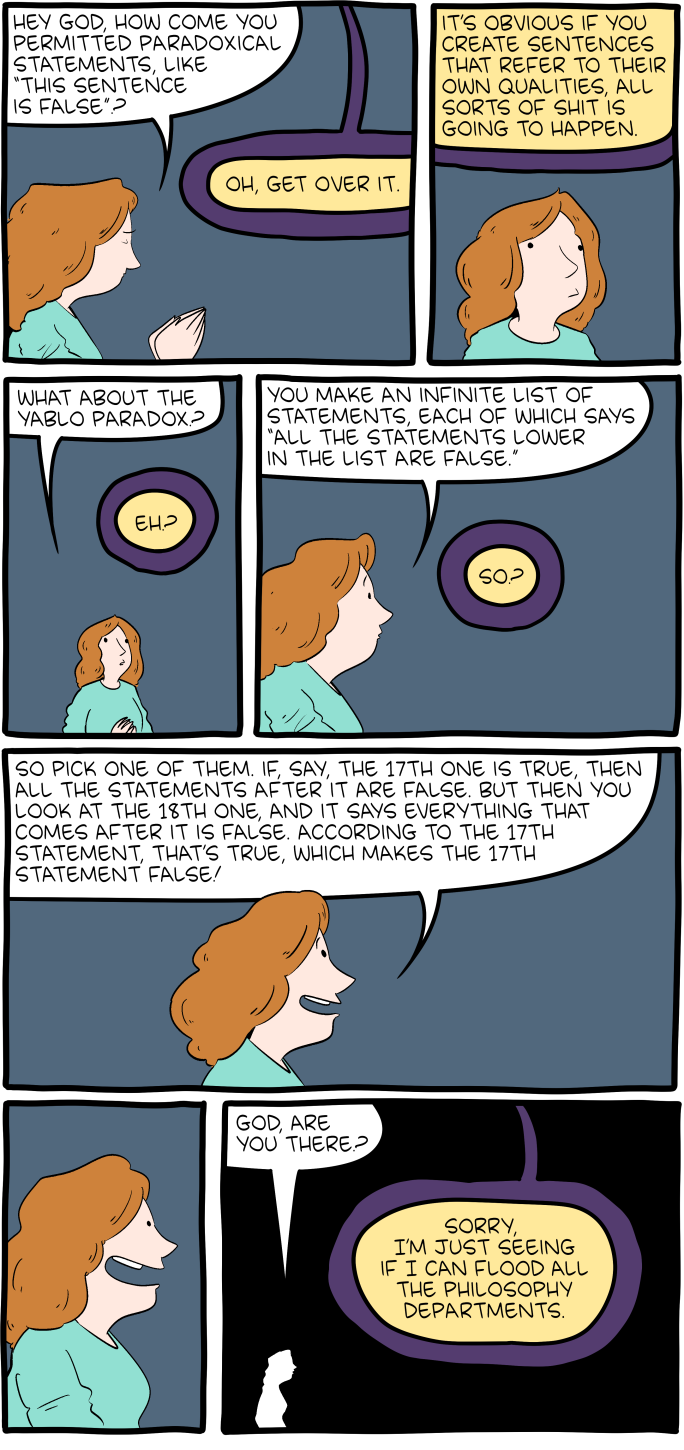
The comic features a conversation about paradoxical statements. One character tells another (who appears to be God): "Hey God, when you come, you admitted to paradoxical statements, like 'this sentence is false.'" God responds that this is because some sentences that appear to refer to their own truth value don't actually resolve to either true or false -- they're not really "going to happen" in any meaningful sense. The character says "Get over it."
The conversation then shifts to a more elaborate paradox. God proposes making a list of statements where each statement says "all the statements lower on the list are false." If one works through the logic: the bottom statement says everything below it is false (there's nothing below, so it's vacuously true), the next one up says everything below is false (but the bottom one is true, so this one is false), and so on, creating an alternating pattern of true and false. But then a statement further up that references the whole list creates a genuine paradox -- it can't consistently be assigned true or false.
God then trails off, and the character asks "God, are you there?" God responds: "Sorry, I'm just sending a complaint to the omniscience department" -- implying that even God's omniscience breaks down when confronted with genuine logical paradoxes.
The comic plays with real concepts from mathematical logic, particularly the liar's paradox and Yablo's paradox (an infinite sequence of sentences each claiming all subsequent sentences are false, which produces a paradox without direct self-reference). The joke is that even an omniscient being -- one who by definition knows everything -- would be stumped by logical paradoxes, because these aren't gaps in knowledge but fundamental limits of logical systems. It's a humorous illustration of Godel-adjacent ideas: some things aren't just unknown, they're unknowable even in principle.