parenting-game-theory
Explanation
The Joke
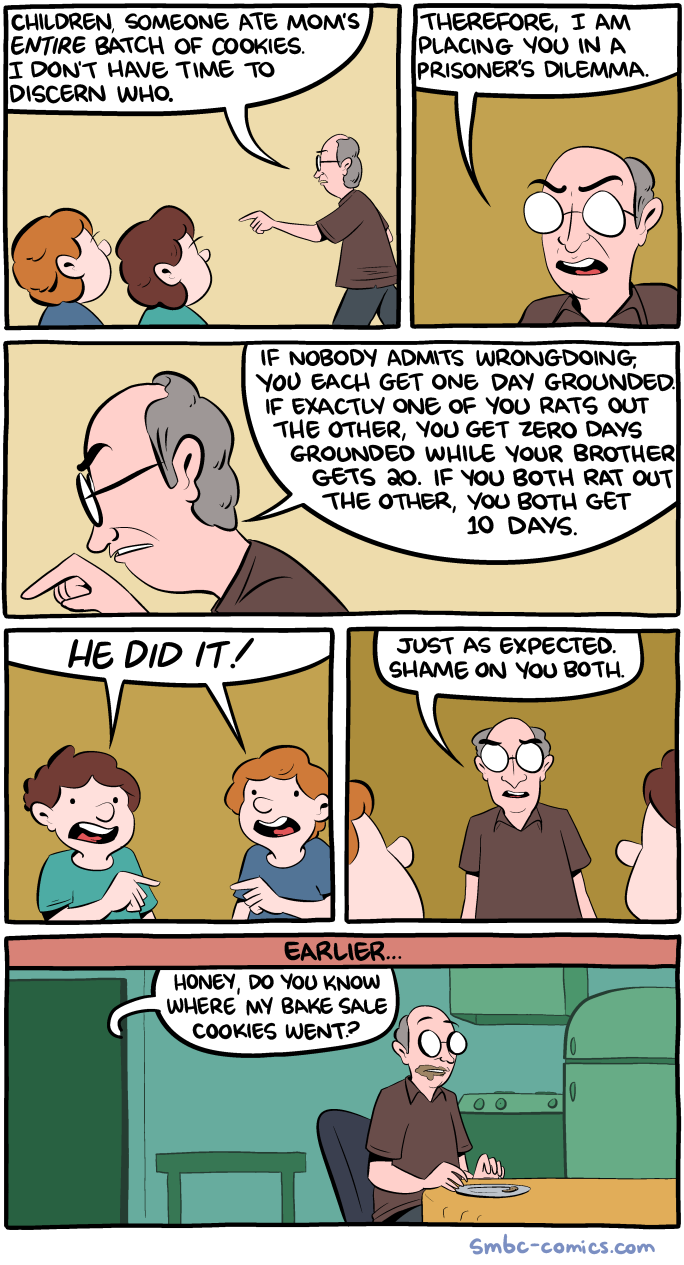
A father discovers that one of his children ate his wife'''s entire batch of cookies but does not know which child did it. Rather than simply punishing both, he announces he is putting them in a Prisoner'''s Dilemma. The rules: if nobody talks, each child gets one day grounded. If one rats out the other, the snitch goes free while the other gets three days grounded. If both rat each other out, they each get two days. One child immediately shouts "He did it!" and the father notes, "Just as expected. Shame on you both!" In the final panel (labeled "Earlier"), the father is shown asking his wife: "Honey, do you know where my third-year game theory cookies went?" -- revealing that he himself ate the cookies and used the scenario as an excuse to run a real-world game theory experiment on his children.
The Humor
The comic operates on multiple levels. First, it takes the classic Prisoner'''s Dilemma -- a foundational concept in game theory -- and applies it literally to parenting, which is already absurd. Second, the child'''s immediate betrayal illustrates the well-known result that rational self-interested actors tend to defect rather than cooperate, even when cooperation would yield a better collective outcome. Third, and most importantly, the final panel reveals the entire setup was a sham: the father ate the cookies himself and manufactured the dilemma purely to test game theory on his own children, making him simultaneously a terrible parent and a dedicated (if unethical) social scientist.
References
The Prisoner'''s Dilemma is a standard example in game theory, originally framed by Merrill Flood and Melvin Dresher in 1950 and formalized by Albert W. Tucker. It demonstrates why two rational individuals might not cooperate even when cooperation is in their mutual best interest. The dominant strategy for each player is to defect (betray the other), leading to a worse outcome than mutual cooperation.