party-game

Explanation
The Joke
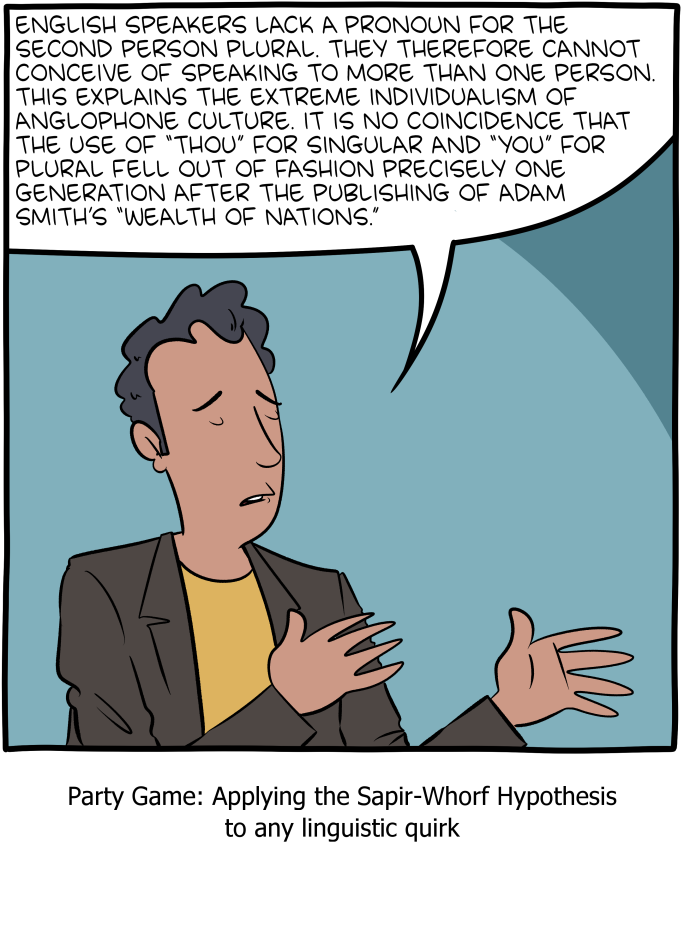
The comic presents a character delivering a mock-academic argument based on the Sapir-Whorf Hypothesis, which proposes that the structure of a language affects its speakers' worldview and cognition. The character notes that English speakers lack a pronoun for the second person plural (i.e., there is no standard distinction between singular "you" and plural "you"), and then makes the absurd logical leap that English speakers therefore "cannot conceive of speaking to more than one person." From this, the character claims this explains "the entire individualism of Anglophone culture," and even connects it to the decline of the word "thou" (the old singular second person) and the rise of Adam Smith's "Wealth of Nations."
The caption below reads: "Party Game: Applying the Sapir-Whorf Hypothesis to any linguistic quirk."
The Humor
The joke satirizes the Sapir-Whorf Hypothesis -- specifically its strong form, linguistic determinism -- by taking it to a ridiculous extreme. While the hypothesis that language shapes thought has some merit in its weak form, the comic demonstrates how easy it is to construct absurd-sounding but superficially plausible arguments by cherry-picking linguistic features and connecting them to vast cultural phenomena. The "party game" framing suggests this is something anyone could do with any language quirk, highlighting how unfalsifiable and slippery such arguments can be.
References
The Sapir-Whorf Hypothesis (also known as linguistic relativity) is a real concept in linguistics, associated with Edward Sapir and Benjamin Lee Whorf. Adam Smith's "The Wealth of Nations" (1776) is the foundational text of modern economics and a key work in the intellectual tradition of individualism.