pascal39s-other-wager

Explanation
The Joke
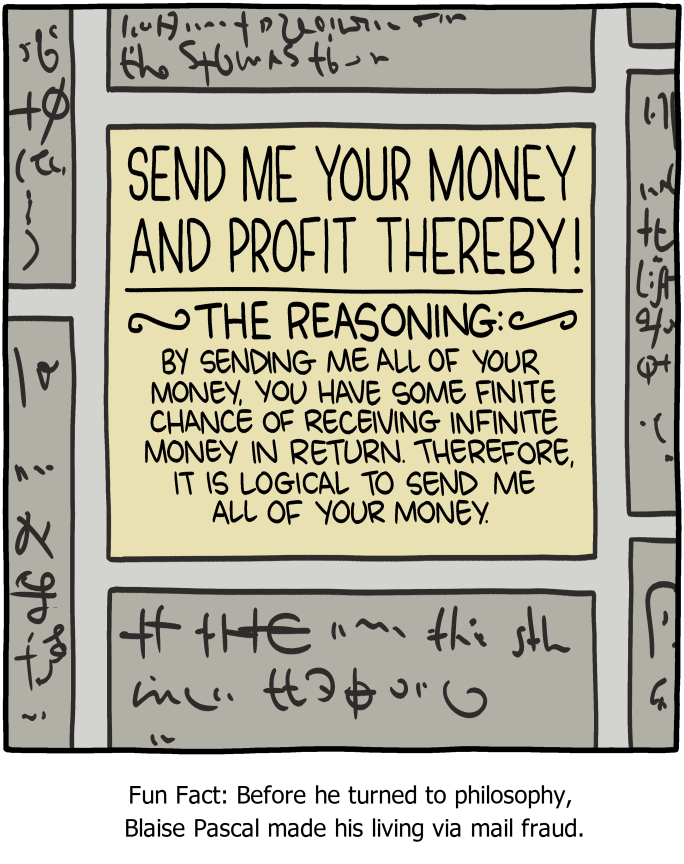
The comic presents a fake historical document styled as a formal announcement, titled "Send Me Your Money and Profit Thereby!" It parodies Pascal's Wager -- the famous philosophical argument by Blaise Pascal that it is rational to believe in God because the potential infinite reward outweighs the finite cost. Here, the "reasoning" section explains that by sending all of your money, you have "some finite chance of receiving infinite money in return," and therefore it is "logical" to send all of your money.
This is a humorous reframing of the expected-value logic behind Pascal's Wager, applied to a blatantly fraudulent money scheme. The argument mirrors the structure of the original wager: if there is even a tiny probability of an infinite payoff, the expected value is infinite, so you should always take that bet. Of course, when applied to a mail scam rather than theology, the absurdity of the reasoning becomes immediately apparent.
The caption at the bottom reads: "Fun Fact: Before he turned to philosophy, Blaise Pascal made his living via mail fraud." This punchline humorously suggests that Pascal first perfected this style of reasoning not for theological purposes, but for running scams -- implying that Pascal's Wager itself is structurally identical to a con artist's pitch.
The Humor
The comedy works on multiple levels. First, there is the direct parody of Pascal's Wager, exposing a well-known criticism: that the same logic could justify any number of absurd propositions if you posit an infinite reward. By transplanting the argument into the context of a mail fraud scheme, Weinersmith makes the logical flaw viscerally obvious. Second, the fake historical framing and the "Fun Fact" caption mimic the format of educational content, adding an extra layer of deadpan humor. The joke is that this is not actually a different argument from Pascal's Wager -- it is structurally the same argument, just applied to money instead of salvation.
References
Pascal's Wager is an argument formulated by the 17th-century French mathematician and philosopher Blaise Pascal. It posits that a rational person should live as though God exists, because if God does exist, the believer gains infinite reward (heaven), and if God does not exist, the loss is finite. Critics have long noted that this argument suffers from the problem of "many gods" and can be used to justify belief in any proposition that promises an infinite payoff, which is exactly the flaw this comic exploits.