past-3
Explanation
The Joke
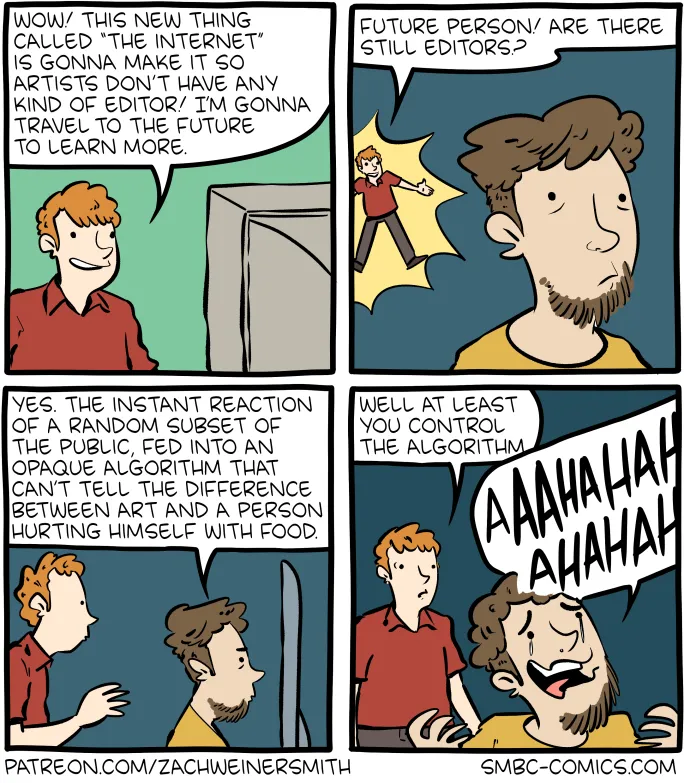
A person from the early internet era is excited that "this new thing called 'the internet' is gonna make it so artists don't have any kind of editor!" and travels to the future to see how this worked out. He asks a future person: "Are there still editors?" The future person explains: "Yes. The instant reaction of a random subset of the public, fed into an opaque algorithm that can't tell the difference between art and a person hurting himself with food." The time traveler tries to console him: "Well at least you control the algorithm." The future person bursts into hysterical laughter: "AAAHAHAH AHAHAH."
The Humor
The comic is a sharp critique of how content creation and artistic expression have evolved in the age of social media and algorithmic curation. The early internet promised liberation from gatekeepers — no more editors, publishers, or executives deciding what art the public gets to see. The punchline reveals that this "freedom" simply replaced human editors with something far worse: an opaque algorithmic system driven by instant public reaction that cannot distinguish between genuine artistic expression and shock content (like someone hurting themselves with food for clicks).
The final panel's hysterical laughter at "at least you control the algorithm" drives home the absurdity — not only do creators not control the algorithm, they barely understand it, and it actively incentivizes the lowest-common-denominator content. The joke captures a widespread frustration among artists and creators who find themselves beholden to engagement metrics, trending algorithms, and the whims of platforms like YouTube, TikTok, and Instagram. The old gatekeepers were imperfect, but at least they were human and legible. The new gatekeepers are inscrutable recommendation engines optimizing for engagement rather than quality.