past-3
Explanation
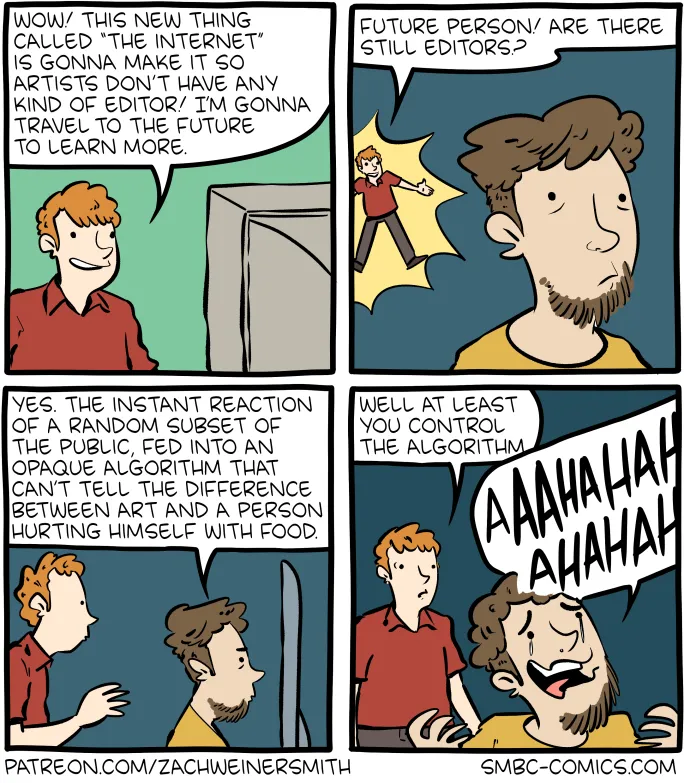
This comic is a satire about the early internet's promise of creative freedom versus the reality of how online content is actually curated and consumed today.
In the first panel, a person from the past enthusiastically declares: "Wow! This new thing called 'the internet' is gonna make it so artists don't have any kind of editor! I'm gonna travel to the future to learn more." This captures the genuine early-internet optimism that disintermediation -- cutting out gatekeepers like editors, publishers, and studios -- would liberate artists.
The time traveler arrives in the future and asks: "Future person! Are there still editors?" The future person responds with a description that is technically accurate but deeply dispiriting: "Yes. The instant reaction of a random subset of the public, fed into an opaque algorithm that can't tell the difference between art and a person hurting himself with food."
This is a pointed critique of how social media algorithms function as the new editors. The old editors were individual humans with taste and judgment; the new "editors" are engagement-driven algorithms that optimize for clicks and reactions. The algorithm cannot distinguish between genuine artistic expression and shock content (like someone injuring themselves with food for views), because both generate engagement metrics. The "random subset of the public" refers to how early engagement from whoever happens to see a post first determines its algorithmic fate.
The punchline lands when the future person adds: "Well, at least you control the algorithm." The time traveler breaks into hysterical laughter -- "AAAHAHAH AHAHAH" -- because the idea of any individual creator controlling the algorithm is laughably absurd. Content creators are entirely at the mercy of opaque, constantly shifting algorithms they have no insight into or control over. The comic's point is that artists traded one set of gatekeepers (human editors) for a far worse one (inscrutable algorithms), while believing they were gaining freedom.