path-of-a-hero

Explanation
The Joke
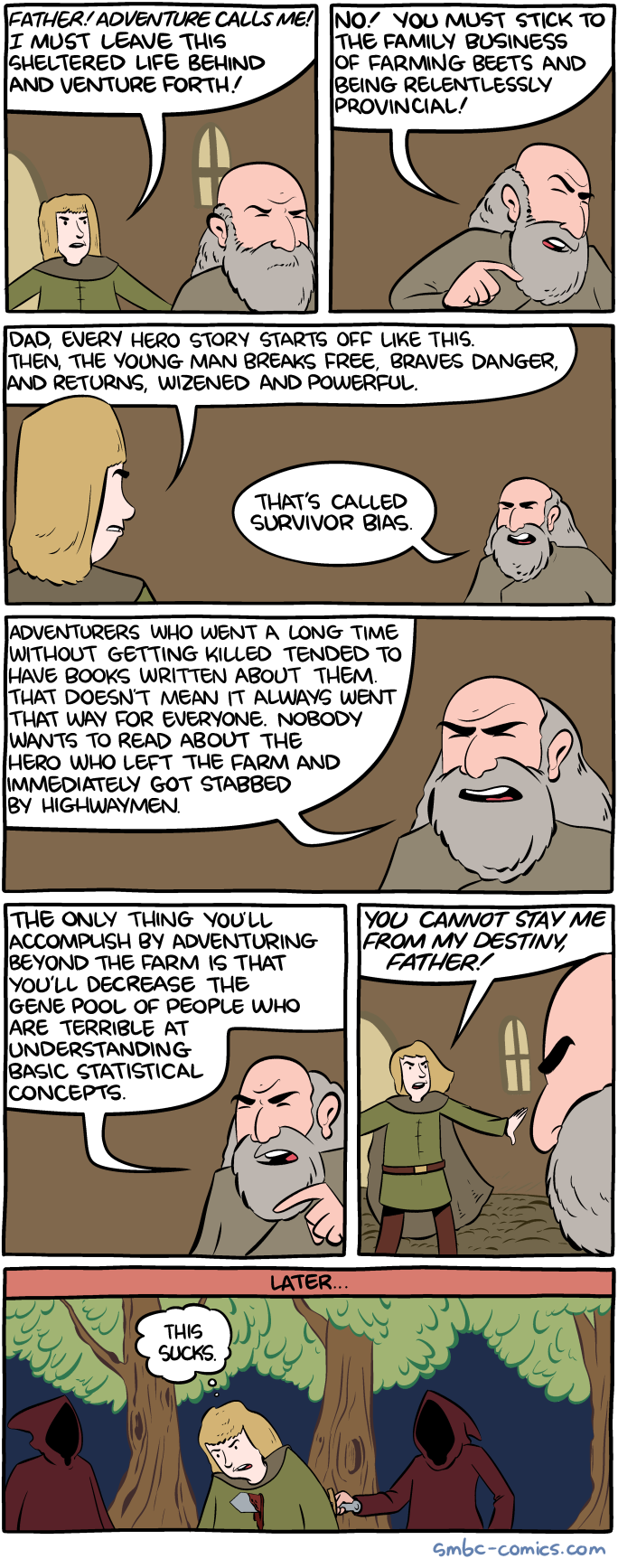
The comic plays on the classic fantasy "hero''s journey" trope. A young man tells his father that adventure calls and he must leave their sheltered life of farming beets and being relentlessly provincial. His father objects, insisting he stay. The son argues that every hero story starts this way -- the young man breaks free, braves danger, and returns wizened and powerful.
The father delivers a devastating rebuttal: "That''s called survivorship bias." He explains that adventurers who went a long time without getting killed tended to have books written about them, but that does not mean it always went that way. Nobody wants to read about the hero who left the farm and immediately got stabbed by highwaymen. He further argues that the only thing adventuring accomplishes beyond the farm is decreasing the gene pool of people who are terrible at understanding basic statistical concepts.
Despite this ironclad statistical reasoning, the final panel shows the son heading off on his quest anyway, with the father muttering "This sucks" -- and the son indeed walking off into the fantasy landscape.
The Humor
The comic is funny because it applies cold, modern statistical reasoning to a beloved fantasy narrative trope. Survivorship bias -- the logical error of focusing on successful examples while ignoring failures -- perfectly explains why every fantasy hero story features someone who left home and succeeded: you never hear about the ones who died in the first mile. The father''s argument is logically airtight, making the hero''s journey sound less like destiny and more like a terrible actuarial decision. The punchline is that despite the father''s impeccable reasoning, the son goes anyway, because narrative destiny trumps statistics in fiction.
References
Survivorship bias is a well-known cognitive bias and statistical error, famously illustrated by Abraham Wald''s World War II analysis of bomber damage. The "hero''s journey" or "monomyth" was formalized by Joseph Campbell in "The Hero with a Thousand Faces" (1949), describing the common narrative structure where a hero departs their ordinary world, faces trials, and returns transformed. The comic also references the general fantasy trope of the reluctant farmer-turned-hero, as seen in works like "The Lord of the Rings," "Star Wars," and countless other stories.