Paw
Explanation
The Joke
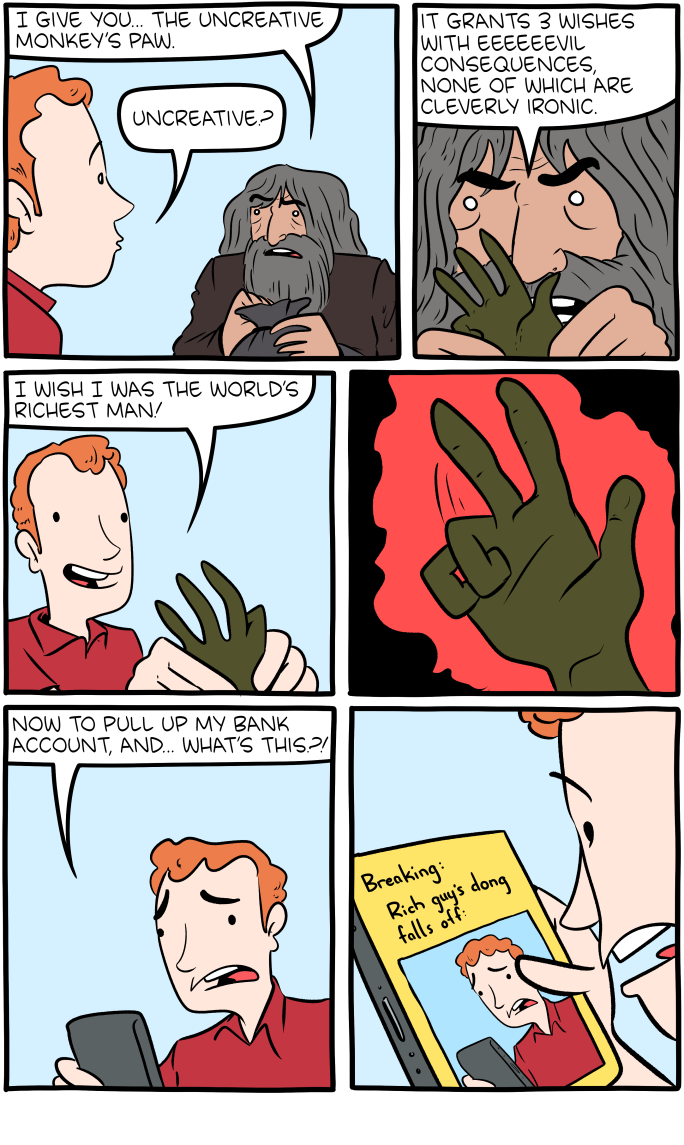
The comic is a riff on the classic "Monkey's Paw" story. A man holds a monkey's paw and makes wishes, but each wish is granted with an ironic twist. He calls the paw "uncreative" after it grants a wish with predictable, obvious consequences. The paw retorts that "if granting wishes with ironic consequences, none of which are particularly clever" is uncreative, then the man should consider his own lack of imagination.
The man then wishes to be the world's richest man, and asks to pull up his bank account to see the result. The final panel reveals the paw's work: a book titled something like "Banking: Kill my family" -- implying the paw made him rich through the horrible death of his family members (a life insurance payout or inheritance), which is the most cliched monkey's paw outcome possible.
The Humor
The comic is a meta-joke about the Monkey's Paw trope itself. The man criticizes the paw for being uncreative in its ironic twists, and the paw essentially agrees but throws the criticism back -- pointing out that the wisher is equally uncreative for making such obvious wishes. The final panel confirms the paw's lack of imagination by delivering the most predictable twist possible (killing the family to grant wealth). The humor comes from both the self-awareness of the trope and the fact that even after being called out, neither the paw nor the wisher can escape the formulaic pattern.
References
"The Monkey's Paw" is a 1902 horror short story by W.W. Jacobs. In it, a couple receives a magical monkey's paw that grants three wishes, but each wish comes with terrible consequences. The most famous element is the couple wishing their dead son back to life, only to realize he would return in his mangled state. The story has become one of the most referenced and parodied horror premises in popular culture, appearing in everything from "The Simpsons" to "Rick and Morty." This comic satirizes how overused and predictable the trope has become.