perception-of-colors

Explanation
The Joke
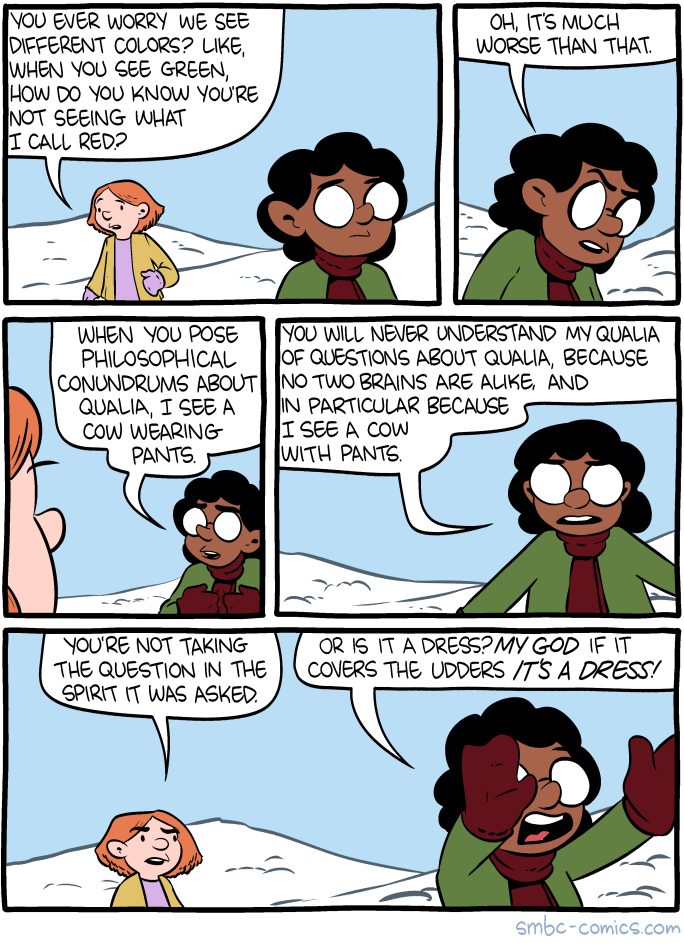
One character poses the classic philosophical thought experiment: "You ever worry we see different colors? Like, when you see green, how do you know you are not seeing what I call red?" The other character responds, "Oh, it is much worse than that." She explains that when people pose philosophical conundrums about qualia, she sees a cow wearing pants. She elaborates: "You will never understand my qualia of questions about qualia, because no two brains are alike, and in particular because I see a cow with pants."
The first character objects that the second is not taking the question in the spirit it was asked. The second character, now fully absorbed in her vision, wonders aloud: "Or is it a dress? My God, if it covers the udders, it is a dress!"
The Humor
The joke takes the famous "inverted qualia" thought experiment and applies it recursively. The original question asks whether two people might have different subjective experiences of the same color. The second character takes this to a more absurd level: not only might our sensory experiences differ, but her subjective experience of hearing a philosophical question is to hallucinate a cow in clothing. This makes the point (humorously) that the problem of qualia is even deeper than the color question suggests -- we cannot even be sure that two people experience the same thing when hearing the same abstract idea.
The final panel''s shift into a heated internal debate about whether the cow is wearing pants or a dress is a perfect comedic escalation. It abandons the philosophical discussion entirely in favor of an urgent sartorial question about imaginary bovine clothing, echoing the famous internet debate about whether a particular garment was blue-and-black or white-and-gold.
References
The "inverted spectrum" or "inverted qualia" thought experiment is a classic problem in the philosophy of mind, often attributed to John Locke, who discussed it in his 1689 Essay Concerning Human Understanding. Qualia (singular: quale) are the subjective, conscious experiences of sensory perception -- the "what it is like" to see red, taste chocolate, or feel pain. The problem highlights the difficulty of knowing whether another person''s inner experiences are the same as one''s own, even when they use the same words to describe them. This is closely related to the broader "hard problem of consciousness" described by philosopher David Chalmers.