perspective-3

Explanation
The Joke
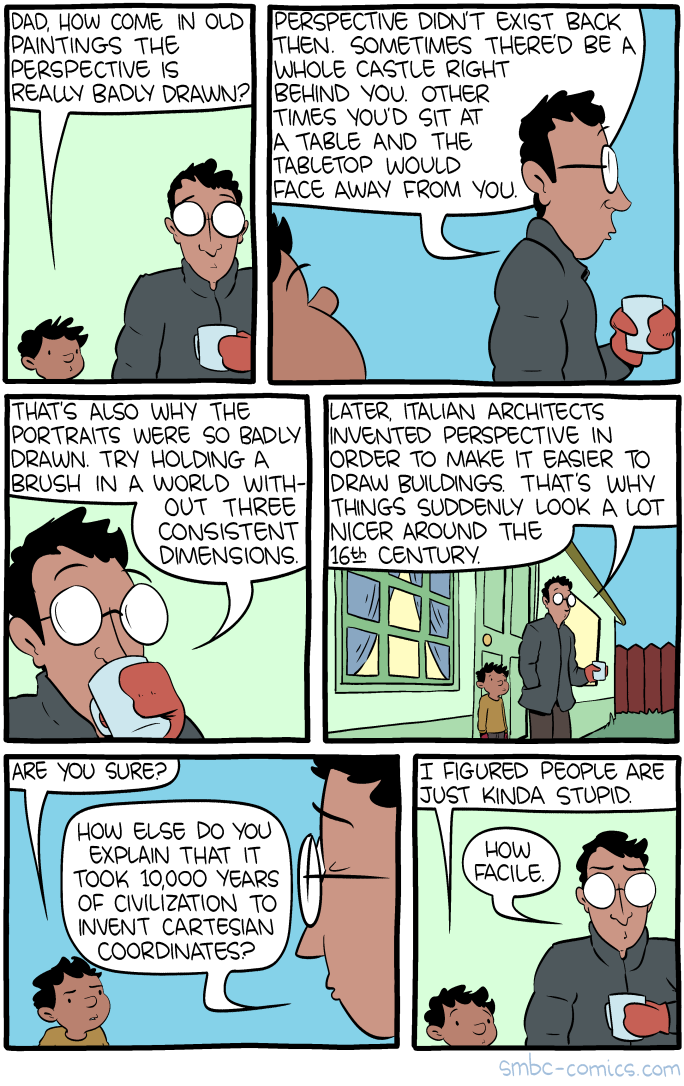
A person expresses frustration about perspective in art: "Why how come in old paintings the perspective is really bad? Ordinary?" Another person explains that people didn''t just "not know" about perspective -- they weren''t stupid. Before linear perspective was formalized, artists could still see the real world just fine. They knew that a castle didn''t actually shrink when you walked away from it, and that a table had four sides even when viewed at an angle.
The explainer continues that Italian architects invented linear perspective in order to make it easier to draw buildings, and that it was a convention that became standard -- not a discovery of how vision "really" works. He notes that perspective involves numerous conventions that aren''t strictly consistent with how we actually see. The first person then asks: "So you''re saying it took genius to invent Cartesian coordinates?" The explainer responds: "How else do you explain that it took so long?" In the final panel, a different observer notes: "Expected response: people are kinda stupid."
The Humor
The comedy comes from the tension between two competing explanations for the same historical fact. The sophisticated explanation is that pre-Renaissance art lacked linear perspective not because people were dumb, but because perspective is a specific artistic convention that had to be invented. The simple (and funnier) explanation is that people were just kind of stupid for a really long time. The comic walks the audience through the nuanced, charitable, art-historical argument, only to have a character undercut it with the blunter take.
There is also humor in the way the comic subtly acknowledges that both explanations have some truth: it genuinely did take millennia for humans to formalize perspective and Cartesian coordinates, which either says something profound about the difficulty of abstracting spatial relationships, or something unflattering about how long humans can go without noticing obvious patterns.
References
Linear perspective in art was formalized in the early 15th century by Italian architect Filippo Brunelleschi and later codified by Leon Battista Alberti in his treatise "De Pictura" (1435). Before this, medieval and ancient art used various non-perspective spatial conventions. Cartesian coordinates, developed by Rene Descartes in the 17th century, provided a mathematical framework for mapping space using perpendicular axes -- another formalization of spatial reasoning that took surprisingly long to emerge given its apparent simplicity.