philosophy

Explanation
The Joke
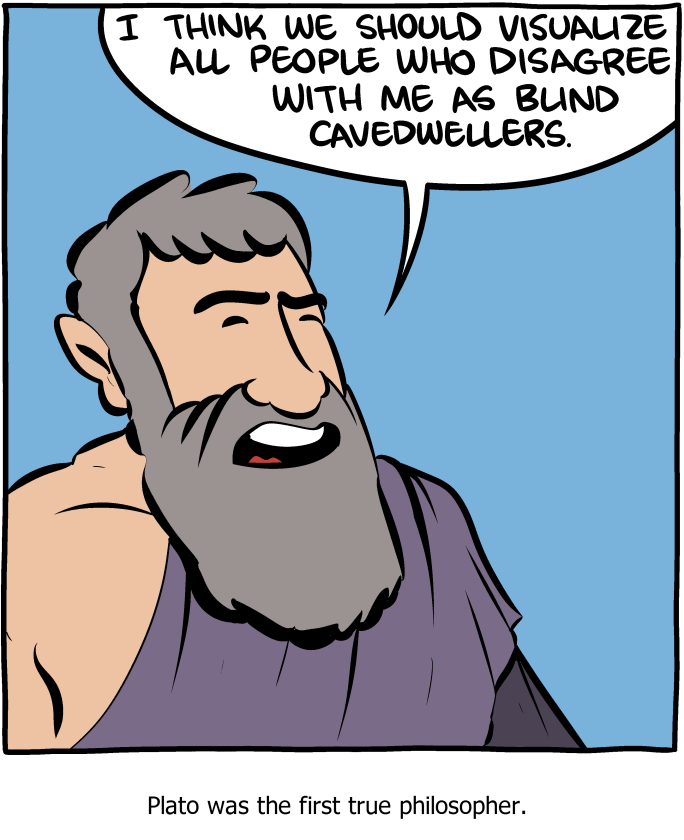
The comic shows a bearded man in ancient Greek attire (clearly meant to be Plato) declaring: "I think we should visualize all people who disagree with me as blind cavedwellers." The caption below reads: "Plato was the first true philosopher."
This is a satirical reinterpretation of Plato's famous Allegory of the Cave from The Republic. In the original allegory, prisoners chained inside a cave can only see shadows on the wall and mistake them for reality, while the philosopher who escapes the cave and sees the sunlight understands true reality. Plato used this as a metaphor for philosophical enlightenment versus ignorance. The comic strips away the high-minded philosophical framing and reduces the allegory to its most uncharitable interpretation: Plato basically invented a very elaborate way of calling everyone who disagrees with him ignorant.
The Humor
The comedy comes from the deflation of one of Western philosophy's most celebrated thought experiments. By putting Plato's actual rhetorical strategy into plain, blunt language, the comic reveals something genuinely funny about the Allegory of the Cave: for all its elegance, it does essentially amount to saying "people who see things differently from me are trapped in darkness." The caption calling him "the first true philosopher" adds an extra layer, suggesting that this kind of move -- framing your opponents as fundamentally incapable of perceiving reality -- is the defining characteristic of philosophy itself.
References
- Plato's Allegory of the Cave: Found in Book VII of The Republic (circa 375 BCE), this is one of the most famous passages in Western philosophy, using the metaphor of prisoners in a cave to illustrate the difference between appearances and reality, and the philosopher's journey toward true knowledge.