phish

Explanation
The Joke
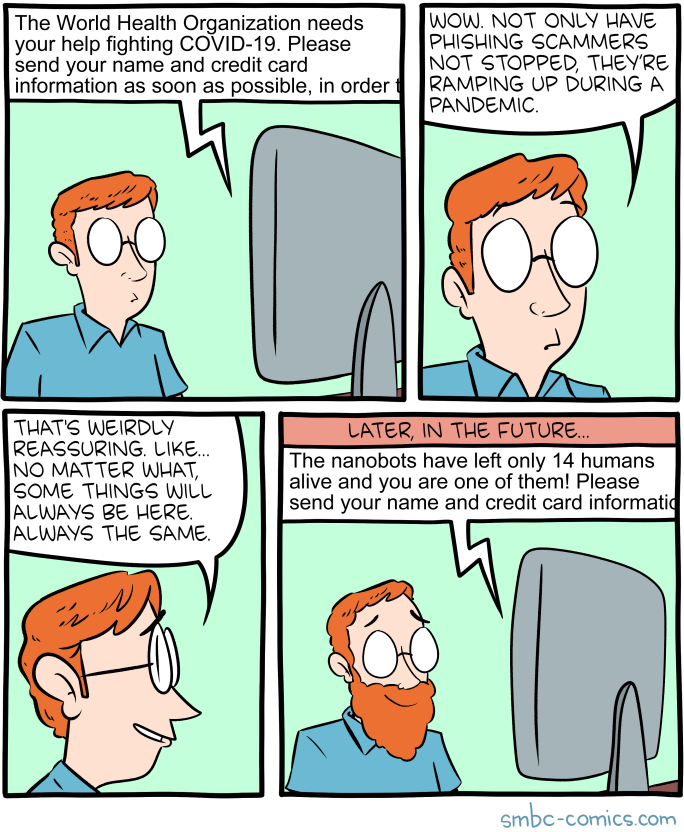
The comic opens with a classic phishing email scenario: a message claims to be from the World Health Organization saying it needs your name and credit card information to help fight COVID-19. A man at his computer recognizes it immediately as a scam, declaring, "That's mercy phishing! No matter what happens, those emails will always be here, always be the same."
The second panel, labeled "Later in the future," reveals a grim twist: "The nanobots have left only 14 humans alive and you are one of them! Please send your name and credit card information." Even after an apocalyptic scenario where nanobots have nearly wiped out humanity, the phishing emails persist, still using the exact same formula -- just with updated catastrophic context.
The Humor
The joke plays on the universal experience of receiving phishing emails and the sense that they are an eternal, indestructible feature of human civilization. No matter how much the world changes -- even if nanobots destroy nearly all of humanity -- scam emails will survive and continue to use the same transparent tactics. The humor comes from the absurd persistence of phishing: it is presented as more durable and resilient than human civilization itself. There is also a layer of topical humor, as the comic was published during the COVID-19 pandemic when pandemic-themed phishing scams were indeed proliferating.
References
Phishing is a type of cybercrime where scammers send fraudulent messages designed to trick recipients into revealing personal information. COVID-19-themed phishing attacks surged in early 2020, with scammers impersonating organizations like the WHO. The comic was published on April 13, 2020.