picture-language

Explanation
The Joke
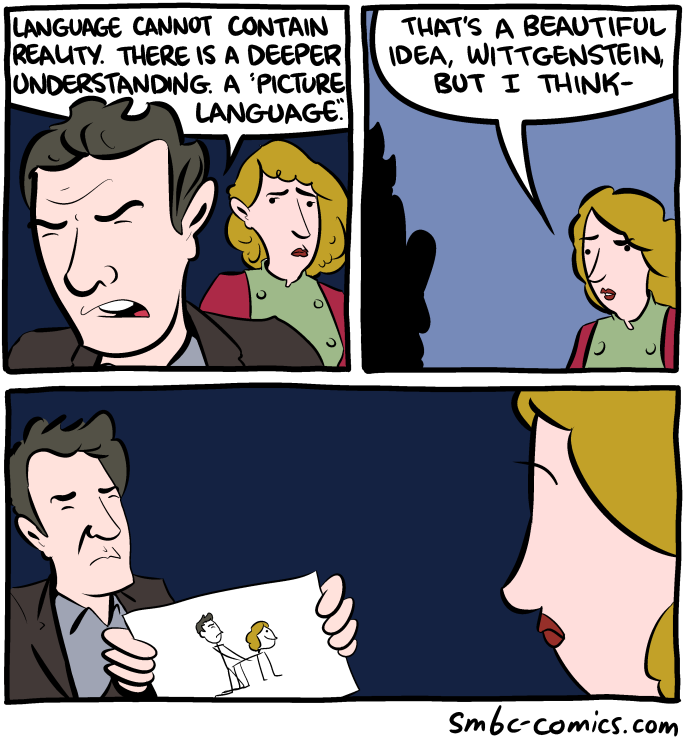
A man identified as Wittgenstein passionately declares: "Language cannot contain reality. There is a deeper understanding: a 'picture language.'" A woman responds, "That's a beautiful idea, Wittgenstein, but I think--" before he cuts her off by holding up a crude stick-figure drawing of two people, apparently depicting something sexual or romantic. The implication is that his grand philosophical concept of a "picture language" that transcends words has been reduced to a childish doodle.
The Humor
The comic takes Ludwig Wittgenstein's actual philosophical concept -- the "picture theory of language" from his Tractatus Logico-Philosophicus -- and literalizes it in the most reductive way possible. Wittgenstein genuinely argued that propositions are "pictures" of reality, meaning language maps onto facts in the world the way a picture represents a scene. This was a serious and influential philosophical idea.
The joke is that when Wittgenstein presents his "picture language" as something that goes deeper than words, the audience expects something profound. Instead, he just holds up a crude drawing -- the kind of thing a child might pass in class. The gap between the grandiose philosophical framing ("language cannot contain reality") and the juvenile reality of the "picture" creates the comedy. It also pokes fun at how even the most sophisticated philosophical ideas can be embarrassingly deflated when taken literally.
References
Ludwig Wittgenstein (1889-1951) was one of the most influential philosophers of the 20th century. His "picture theory of meaning," developed in the Tractatus Logico-Philosophicus (1921), proposed that language works by creating logical "pictures" of possible states of affairs in the world. Wittgenstein later largely rejected this theory in his Philosophical Investigations (published posthumously in 1953).