pie

Explanation
The Joke
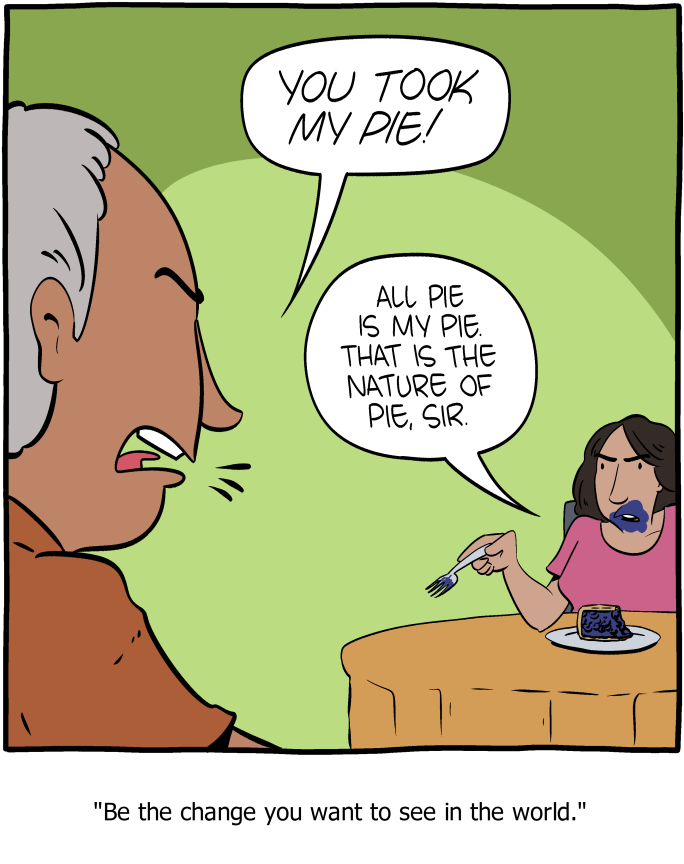
An older man angrily accuses someone of taking his pie: "You took my pie!" A younger man with long dark hair, calmly eating the pie with a fork, responds with serene philosophical authority: "All pie is my pie. That is the nature of pie, sir." The caption below reads: '"Be the change you want to see in the world."'
The joke is that the pie thief has elevated simple theft into a philosophical stance, speaking with the calm certainty of a guru or mystic. Rather than denying the theft or apologizing, he reframes reality itself: pie, by its very nature, belongs to him. This is presented with the unshakable confidence of someone stating a self-evident truth.
The Humor
The comedy works through the contrast between the pettiness of the crime (stealing a slice of pie) and the grandiosity of the justification. The thief speaks like a spiritual teacher delivering an eternal truth, and the famous Gandhi-attributed quote in the caption ("Be the change you want to see in the world") reframes his pie theft as a form of aspirational self-actualization. The alt text ("I don't believe in the concept of personal property that isn't mine") extends the joke by revealing the thief's philosophy to be a perfectly circular form of selfishness dressed up as principled belief. The comic satirizes how people use lofty philosophical or spiritual language to justify self-serving behavior.
References
- "Be the change you want to see in the world": A quote widely (though somewhat inaccurately) attributed to Mahatma Gandhi. The actual Gandhi quote is longer and less pithy, but this paraphrased version has become a ubiquitous motivational slogan.
- The comic parodies the archetype of the serene philosophical figure who redefines morality to suit their own desires, a trope that appears everywhere from Eastern philosophy parodies to Silicon Valley "disruption" rhetoric.