Planned Economics

Explanation
The Joke
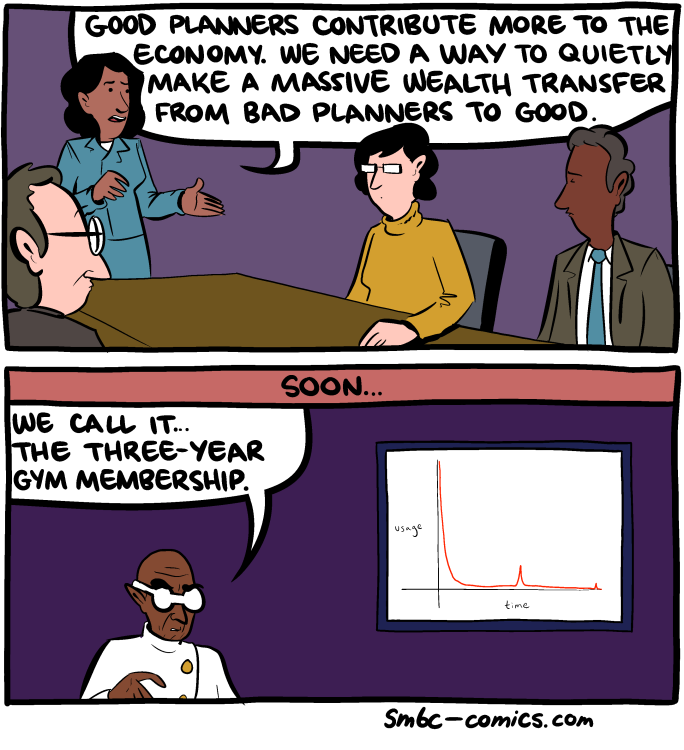
In the first panel, a group of people sit around a conference table. One person states: "Good planners contribute more to the economy. We need a way to quietly make a massive wealth transfer from bad planners to good." The next panel, captioned "Soon...", shows the solution being presented: "We call it... the three-year gym membership." A graph is displayed showing gym usage spiking immediately after purchase and then plummeting to near zero shortly afterward.
The Humor
The joke is built on the universally recognized phenomenon of people enthusiastically signing up for long-term gym memberships and then never going. The comic reframes this common behavioral pattern as a deliberate, planned economic policy -- a wealth transfer mechanism from "bad planners" (people who overestimate their future motivation to exercise) to "good planners" (presumably the gym owners and those who accurately predict human behavior).
The humor works because the observation is deeply relatable -- gym memberships are one of the most common examples of the "planning fallacy," where people overestimate their future willpower and consistency. The graph showing the sharp spike and immediate dropoff in usage is a familiar pattern that anyone who has joined a gym in January can recognize. By framing this well-known consumer trap as an intentional government policy for economic optimization, the comic both satirizes central economic planning and highlights how predictably irrational human behavior can be.
References
- Planned Economy: The title "Planned Economics" references centrally planned economies where the government controls economic decisions, as opposed to free-market systems.
- Planning Fallacy: A cognitive bias identified by Daniel Kahneman and Amos Tversky where people underestimate the time, costs, and risks of future actions while overestimating their benefits. Gym membership purchasing is a textbook example.
- Studies have consistently shown that a large percentage of gym memberships go unused, with some estimates suggesting that gyms depend on the majority of members not actually showing up regularly.