poetry-2
Explanation
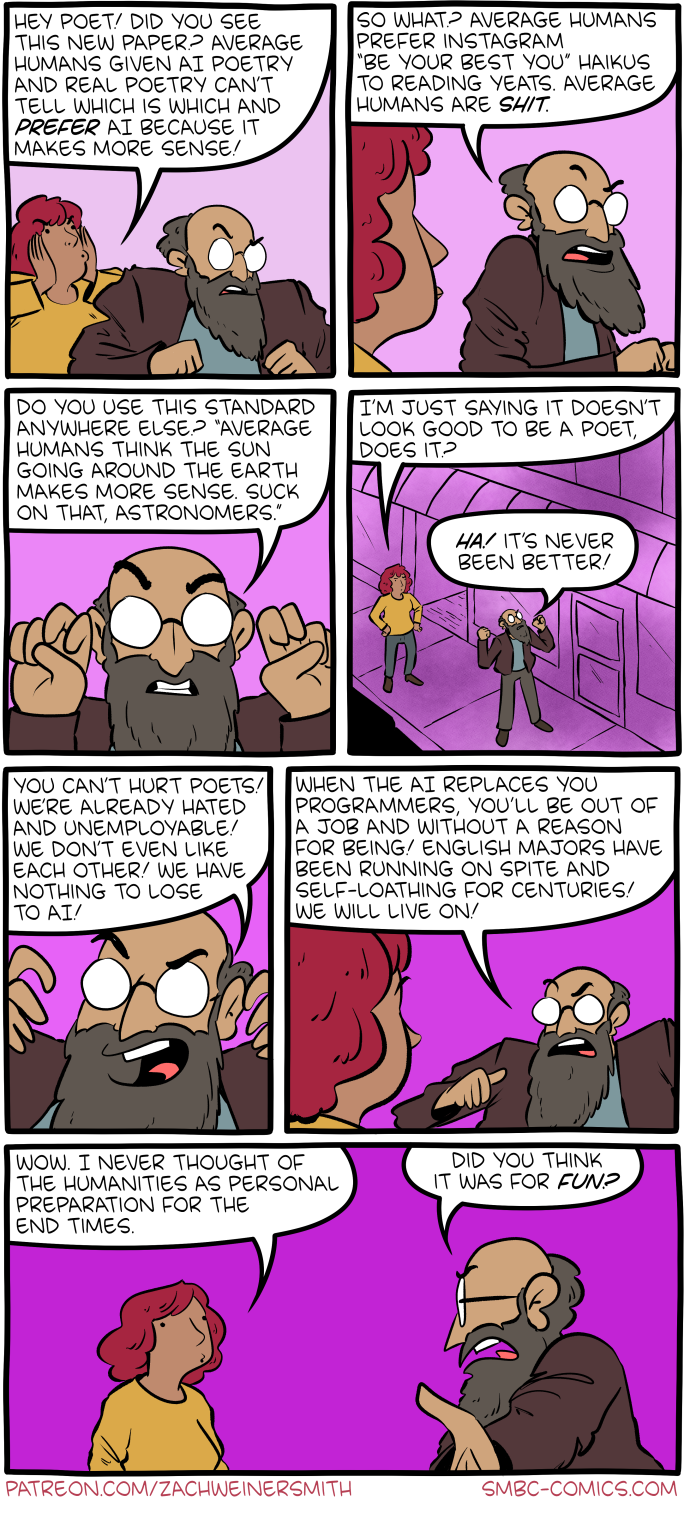
This comic features a conversation between two characters about the state of poetry. One character excitedly reports: "Hey, poet! Did you see the new report? Average humans exposed to randomly generated haiku showed no statistical difference in response to reading real average poetry!" The poet's reaction is defensive concern.
The conversation escalates: "Do you use the standard iambic verse? It's a known format going around the Earth — when was the last time you tried anything not astronomical?" The poet pushes back: "I'm just saying it doesn't look good to be a poet when programmers, you'll be out of — " and the other responds "Ha! It's never been better!"
The final twist: "You can't — most poets were already wired to be programmers. You'll be out of a job eventually. LLMs have been running on GPTs and they haven't stopped." The poet responds: "Hmm, I never thought of it as preparation for the job market."
The comic satirizes several interrelated anxieties: the cultural marginalization of poetry, the threat AI poses to creative professions, and the uncomfortable question of whether average poetry is distinguishable from randomly generated text. The joke cuts in multiple directions — it mocks the idea that poetry's value can be measured by whether readers can distinguish it from random output, while simultaneously acknowledging the uncomfortable truth that much mediocre poetry may indeed be indistinguishable from noise. The conversation about poets becoming programmers inverts the usual narrative (programmers worried about AI taking their jobs) and suggests that poets, already accustomed to producing work that nobody reads or values commercially, may be better prepared for a post-AI economy than anyone expects. It is a characteristically SMBC exploration of how technological disruption forces us to question what we actually value about human creative output.